
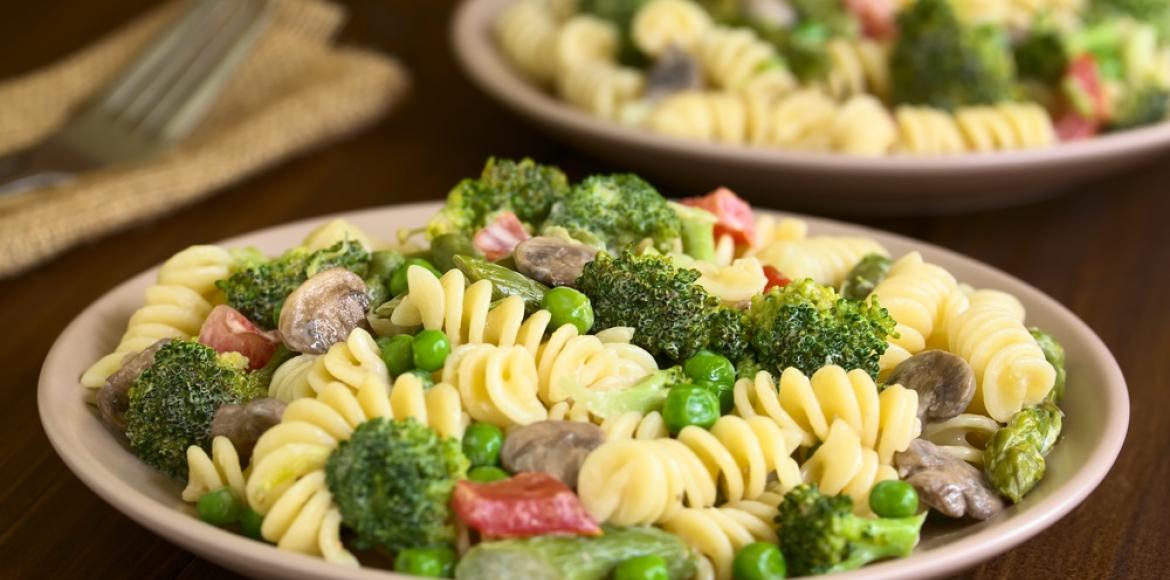
Concrete ideas, based on science, to improve the nutritional quality of your meals and avoid blood sugar peaks. With advice from Dr. Alan Barclay, author of The right carbohydrates.
Whether you are in good health or have excessively high blood sugar, it is good to monitor the glycemic index (GI) of your dishes to avoid the peaks that follow certain meals. These blood sugar peaks stimulate the secretion of insulin by the pancreas; they also cause a drop in energy, a feeling of hunger and lead to excess weight in sedentary people. In the long term, they can promote insulin resistance, diabetes and cardiovascular disease. Here are some tips to limit them.
1: Mix vegetables into your dishes
Vegetables have a low glycemic index (GI). “You can lower the glycemic index of a pasta or rice dish by reducing the amount of starch on the plate and replacing it with an equivalent quantity of vegetables”says Dr Alan Barclay, of the University of Sydney, member of the team of researchers who developed the glycemic index and author of the book The right carbohydrates. For example, by mixing equal parts zucchini or eggplant and pasta. It’s a tasty and quick way to better control your blood sugar and improve the nutritional density of dishes.
2: Invite soluble fiber
Fiber, and especially soluble fiber, lowers the GI. Thus, compared to a breakfast with 2.2 g of fiber, a breakfast with twice as much fiber (4.9 g) leads to a 46% reduction in GI (1).
By adding oat bran (or psyllium for those with gluten intolerance) to flour-based preparations (bread, cake, pie, etc.), we increase the soluble fiber content of the preparation. Concretely, we simply replace one part of flour with one part of oat bran.
3: Eat protein
“In addition to delaying gastric emptying and slowing the absorption of carbohydrates, proteins are able to interact with starch granules present in starchy foods, slowing down their digestion and absorption”says Dr. Barclay. A slight increase in the share of plant or animal proteins in meals (i.e. 25% of total calories) in healthy people or people with diabetes helps reduce the GI of foods rich in carbohydrates (2).
4: Use fatty substances and sauces (tomato)
Adding fat to foods rich in carbohydrates (extra virgin olive oil, fatty fish, nuts, etc.) reduces their glycemic index. For example, adding tomato sauce (with olive oil) lowers the GI of rice or pasta. Similar results were obtained with cheddar cheese (3).
5: Cook for less time
The longer a carbohydrate food is cooked, the higher its GI. “The reason is, said Dr. Barclaythat cooking food destabilizes starch granules, which allows glucose chains to form gels; This is called gelatinization. This facilitates their digestion and absorption, increasing their GI. » Therefore, favor short cooking times (al dente).
6: Eat your potatoes cold
The glycemic index of potatoes is generally high, so researchers like Professor Walter Willett of Harvard advise eating them in moderation, especially if you are sedentary. But if, after cooking, the starch is allowed to cool (a phenomenon known as retrogradation), the starch granules shrink through loss of water and the particles reorganize into a crystalline structure, called type 3 resistant starch, which opposes digestion (4). “This resistant starch remains intact throughout the intestinal tract and acts in the colon as a prebiotic, serving as food for the intestinal flora”explains Dr. Barclay.
Downgrading their starch lowers the GI of potatoes by almost 30%. If you eat your cold potatoes in salad with vinegar, then the GI is reduced by more than 40%.
7: Put less water in the pot
The amount of liquid in which carbohydrate foods are cooked also influences their GI. Studies have observed that a 2:1 water-to-rice ratio significantly increases the resistant starch content of white rice compared to a 3:1 or 4:1 ratio. Bottom line: Don’t drown your pasta or rice in water (5).
8: Consider the microwave
Depending on the cooking method used, the results on the GI differ. For example, cooking rice noodles in the microwave leads to a higher resistant starch content than cooking in a pan, steam and water, which lowers their GI (6).
9: Add vinegar or lemon
“Vinegar lowers the glycemic index of a meal or dish quite significantly, 15 to 35% on average”says Dr. Barclay. Explanation: acidity slows down gastric emptying, therefore the speed with which carbohydrate foods release their glucose (7).
Vinegar can be used in salad dressing or added to food (rice in sushi), or even for the bravest, swallowed before a meal. Vinegar also improves insulin sensitivity in both healthy people and those who are insulin resistant or have diabetes. If you don’t like the idea of swallowing a tablespoon of vinegar, know that it also works with lemon…
10: Eat sourdough bread
As for bread, choose sourdough breads, preferably wholemeal or semi-wholemeal, with several cereals. Sourdough gives bread a high degree of acidity, which partly inhibits the alpha-amylase enzyme responsible for breaking down starch into glucose. The result is a lowering of the GI, reinforced by the presence of less refined cereals, other than wheat.
11: Consider freezing the bread
Any process that reduces the water content of starchy foods can affect their GI. For example, bread that has been frozen, thawed and then toasted has a lower GI than fresh bread, or directly toasted bread, or frozen and thawed bread (8).
12: Say yes to legumes
To guarantee a soup that will last for the body without containing potatoes, consider lentils, chickpeas, split peas and other dried vegetables in addition to your vegetables. Legumes have low GI, contain fiber and many nutrients. Pulses should be served twice a week (or more if you are vegetarian).
13: Consume carbohydrates at the end of a meal
Studies have shown that eating fiber-rich proteins, fats, and vegetables before consuming starchy foods significantly reduces post-meal blood sugar (up to 73%) and circulating insulin levels (48%) compared to eating starchy foods before or during the meal (9).
14: Eat starchy fruits when they are barely ripe
During their ripening, fruits undergo a series of modifications: the texture of the fruits changes due to the hydrolysis of starches, the reduction of their fiber content and the degradation of cell walls. With the hydrolysis of starches, sugars are formed, providing a sweeter taste. Fruits in which the ripening process continues after harvest (banana, apple, pear, kiwi, peach, melon, plum or fig, among others), see their starch converted into simple sugars (fructose and glucose), thus increasing their GI. On the contrary, in the early stages of maturation, the higher starch content is resistant to digestion, and reaches the colon intact, where the starch will be fermented by the microbiota. Unripe fruits therefore have a moderate to low GI.