
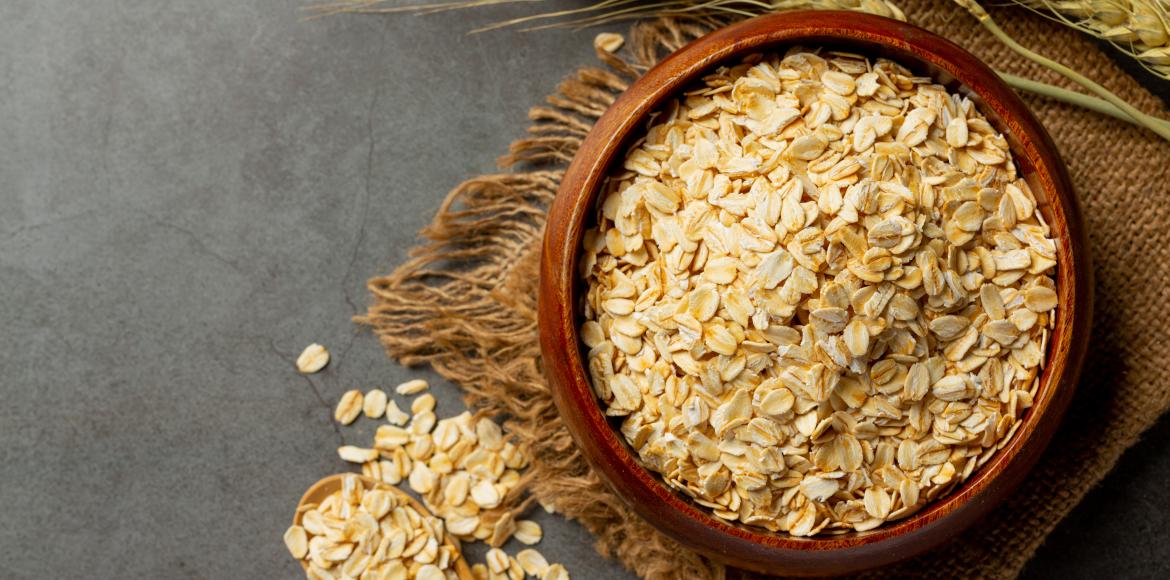
Carried by the wave healthy — porridge, “overnight oats”, homemade granola — oats have become one of the most consumed cereals for breakfast. But behind the image of the “superfood”, what do we really know about its benefits? And above all, are all oat products the same?
A little history
Unlike wheat or barley, domesticated since the Neolithic, oats arrived late on our plates. Its cultivated form descends from a wild oat native to the Fertile Crescent, which long persisted as a simple weed in wheat and barley fields before being domesticated. The oldest remains of actually cultivated oats known to date were found in caves in Switzerland and date from around 1000 BC. BC, several millennia after wheat and barley.
Its real generalization as a food crop in its own right then took place in Northern Europe, precisely because it is one of the rare cereals which tolerates cold and humidity well, where wheat struggles. Hence a culinary tradition that remains very anchored in this geographical area.
Porridge, a universal dish
The idea of cooking cracked grains in water or milk is much older than oats themselves: it dates back around 12,000 years, when humanity moved from gathering to growing grains, well before the invention of bread. The word “porridge” comes from the English pottage, itself from the French potage.
Each region of the world has actually developed its own cereal porridge:
- UNITED STATES : L’oatmealrather sweet (cinnamon, maple syrup, fruit);
- Germany and Scandinavia: Haferbrei, havregrøtvery close to Scottish porridge;
- Eastern Europe and Russia: kasha, a cereal porridge, most often buckwheat, but also oats, barley or millet;
- China and East Asia: THE congeea very diluted and salty rice porridge;
- Sub-Saharan Africa: corn, millet or sorghum porridge (ugali, dad, nsima) ;
- Southern United States: THE gritsa corn porridge.
Each culture has made its most locally available cereal (oats in northern Europe, rice in Asia, corn and millet in Africa, buckwheat in Eastern Europe) its basic preparation. Scottish oat porridge is therefore only a regional variation of a universal culinary principle.
And before today’s sweet, milky porridge, ancestral cereal porridge was often a fermented dish, with a tangy taste, close to that of yogurt or sourdough bread. In Scotland itself, they were preparing sowans : the oat brans were soaked in water for about a week until fermented, before being cooked into a tangy mush; fermentation improves both the digestibility and nutritional value of the grain.
One cereal, many faces
Under the generic term “oats”, we actually find several degrees of processing, which are not nutritionally trivial.
- Whole hulled oats (groats): the raw grain, just removed from its husk. Long cooking time, but most intact structure.
- Cut oats (steel-cut oats): the whole grain simply sliced into 2-3 pieces. Faster cooking, firm texture.
- Traditional flakes (rolled oats): the grain is parboiled then flattened. This is the most common form in France.
- Instant flakes: steamed, flattened very finely, sometimes pre-cooked. They cook in a minute — at the cost of a much more fragmented structure.
- Oat bran: the outer shell of the grain, richest in fiber and beta-glucans by weight.
The finer and precooked a flake is, the more easily its starch is accessible to digestive enzymes and the faster the glycemic response after the meal.
Focus on the glycemic index
Oats have a rather low glycemic index (GI), around 55, comparable to that of quinoa or buckwheat, and significantly lower than that of white rice. This moderate GI is explained by the viscosity of beta-glucans, which slows gastric emptying and the absorption of carbohydrates, but also by the structure of the grain: the less it is processed, the more the starch remains trapped in a fibrous matrix that is difficult to access for digestive enzymes.
This is where the form of the product is important: the GI of 55 cited above corresponds to minimally processed oats (whole grain, cut oats, traditional flakes cooked normally). Precooked instant flakes have a significantly higher GI, sometimes beyond 65-70, simply because precooking and fine rolling have already “predigested” part of the starch. In other words, two packets of “oats” can have a very different glycemic impact depending on their degree of processing, one more argument for preferring the less processed forms.
Oats vs other cereals: nutritional comparison
Here’s how oats stack up against other common grains and pseudo-grains.
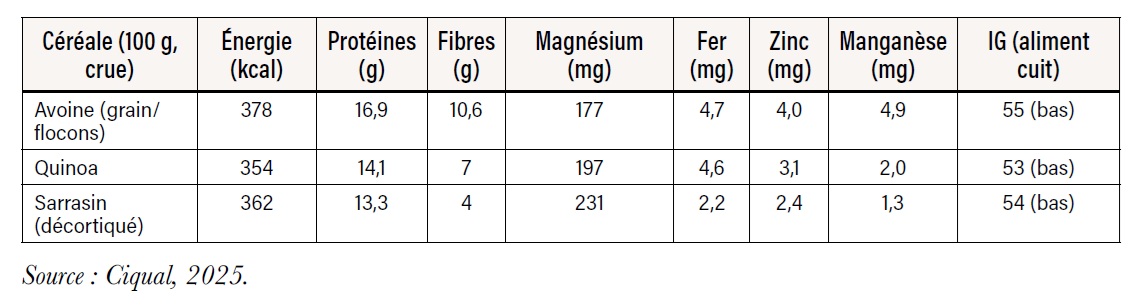
- Oats are the cereal richest in protein of this selection.
- Oats also stand out for their minerals: it is the richest in manganese and among the best equipped with iron and zinc, minerals whose absorption however remains slowed down by phytates.
- Oats are also rich in beta-glucansa specific type of soluble fiber.
What do the studies say?
A recent review (1) on the composition of oats grown in different countries provides an overview.
First observation: oats have a unique protein profile among cereals. Where wheat, rice or corn mainly store their reserves in the form of prolamins, oats rely primarily on globulins, a structural difference which is not just a biochemical detail, since it is this which partly explains why avenin (the equivalent of gluten in oats) is much less problematic for the body than the prolamins of wheat.
Oats are also the cereal richest in fat, with a very interesting profile – few saturated fatty acids, lots of essential unsaturated fatty acids – which makes it an ally for cardiovascular health, just like its fiber.
Indeed, daily consumption of oat beta-glucans modestly lowers total cholesterol and LDL, as well as intestinal glucose absorption. A mechanism which makes it a preventive factor in the face of cardiovascular diseases, dyslipidemia, hypertension, chronic inflammatory state and type 2 diabetes. On this basis, the EFSA has recognized a health claim since 2012: a product can claim an effect on cholesterol if it provides at least 1 g of beta-glucans per serving, provided that you consume 3 g per day in total. An achievable quantity with around 40 to 70 g of daily oat flakes or oat bran, spread over the day.
Oats are also distinguished by their concentration of antioxidant compounds, notably avenanthramides, polyphenols that are found nowhere else in the plant kingdom, and whose antioxidant activity in humans is considered particularly high.
On satiety and blood sugar, the effect is consistent with the physicochemical properties of beta-glucans because they form a viscous gel in the intestine which slows gastric emptying and the absorption of carbohydrates. But this effect depends strongly, as we have seen, on the degree of processing of the product: an industrial instant porridge will not have the same effect as cut oats cooked for a long time.
Last point highlighted by this review: products based on fermented oats are booming as functional foods, due to their probiotic potential: a recent research trend which directly connects with the ancestral traditions of fermented porridges mentioned above (2).
Are oats really “healthy”?
For some time now, a discourse has been circulating on the networks: several health influencers claim that oats do not deserve their reputation, citing gluten, “anti-nutrients” or pesticide residues. These arguments benefit from being put in their rightful place.
Oats and gluten
Oats, botanically, do not contain gluten in the strict sense. Its storage protein, avenin, is different from that of wheat, barley or rye. The problem is almost always cross-contamination: oats are grown, harvested, transported and processed in circuits that also handle wheat, which in practice contaminates them in the vast majority of cases.
This is why “classic” oats are never recommended for people with celiac disease, even if the label does not mention gluten. Only oats specifically grown and processed according to a purity protocol – dedicated channels, fields without rotation with gluten cereals, regular checks – can bear the “gluten-free” label and be considered safe for the majority of celiac people. A minority of them nevertheless remain intolerant to avenin itself, regardless of any contamination.
“Anti-nutrients”
Oats contain phytic acid, which can bind to iron, zinc or calcium and slightly reduce their absorption, as well as small amounts of lectins. This is a real phenomenon, common to most whole grains and legumes, not specific to oats. Its impact is marginal in a diversified and non-deficient diet, and it can be further reduced by simple techniques: soaking the flakes before cooking, or cooking them sufficiently, which degrades some of the phytates.
Pesticide residues, particularly glyphosate
In certain countries (North America in particular, more rarely in the United Kingdom), glyphosate can be sprayed on oats just before harvest as a desiccant, to accelerate and standardize the drying of the grain, a practice which mechanically increases the residues found in the final grain. In France and the European Union, this pre-harvest use has been prohibited since 2021. The real risk therefore largely depends on the origin of the oats: certified French or European oats are not affected by this practice, which is not always the case for cheap imported oats. Generally speaking, we prefer to choose an organic product.
The right answer is therefore not to give up a food that is as interesting for the budget as it is for the plate, but to be more demanding about its origin (French/European oats, if possible organic) and its preparation (cooking, soaking, fermentation).
How to choose it well?
- Prefer traditional flakes or cut oats with instant flakes, for a less processed texture and a more gradual effect on blood sugar.
- Check the ingredient list “ready-to-eat” products (porridges in bags, mueslis, bars): added sugar, glucose-fructose syrup and poor quality oils are frequently used.
- Look for the certified “gluten-free” label if you are affected by celiac disease and never rely on classic oats by default.
In practice
Slowly cooked porridge, overnight oats prepared the day before with milk or a vegetable drink, oats added to bread dough or homemade granola… Oats lend themselves to many uses, and the “raw” format (traditional flakes, cut oats, bran) remains the most nutritionally interesting and economical version.
To extend the link with the fermented traditions seen above, discover a simple way to ferment your own oats at home:
Quick fermented oats (overnight oats style)
• 50 g of traditional oatmeal
• 100 g of natural yogurt or kefir (with live ferments)
• 100 mL of water or milk
• A pinch of salt
Mix all ingredients in a jar, cover and let sit at room temperature for 12 to 24 hours (the longer the fermentation, the tangier the taste and the more the phytates are broken down). Then store in the refrigerator. To reheat gently, with fruit, seeds or a drizzle of honey. This quick version, inspired by overnight oats but fermented, takes advantage of the ferments of yogurt or kefir rather than spontaneous fermentation.
Other recipes with oats:
-
Oatmeal cookies
-
Low GI blinis with oat bran
-
Chia and oat aperitif cookies