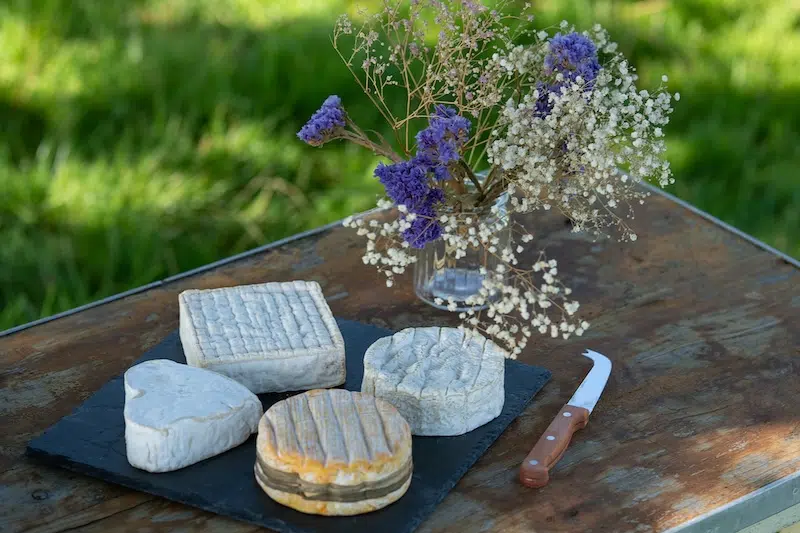
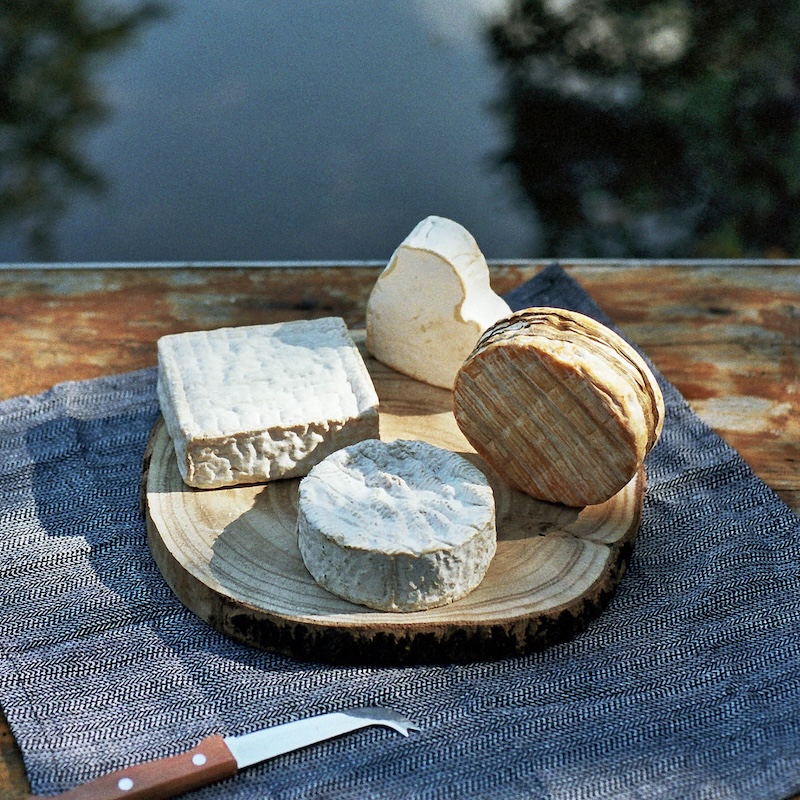
Pont-l’Évêque is an AOP cow’s milk cheese with a soft paste and washed rind, recognizable by its square shape and its generous aromas of cream, hazelnut, undergrowth and hay.
Born in the heart of Normandy, like Camembert, Livarot and Neufchâtel, Pont-l’Évêque is one of the oldest French cheeses. Behind its astonishing square shape hides a cheese with a character full of nuances: a supple and melting paste, a whitish to orange rind, and aromas which evolve with maturation, from cream and butter to the undergrowth and the stable. Protected by an AOP since 1996, it remains today closely linked to the Normandy countryside and the cow’s milk produced there.
What is its story?
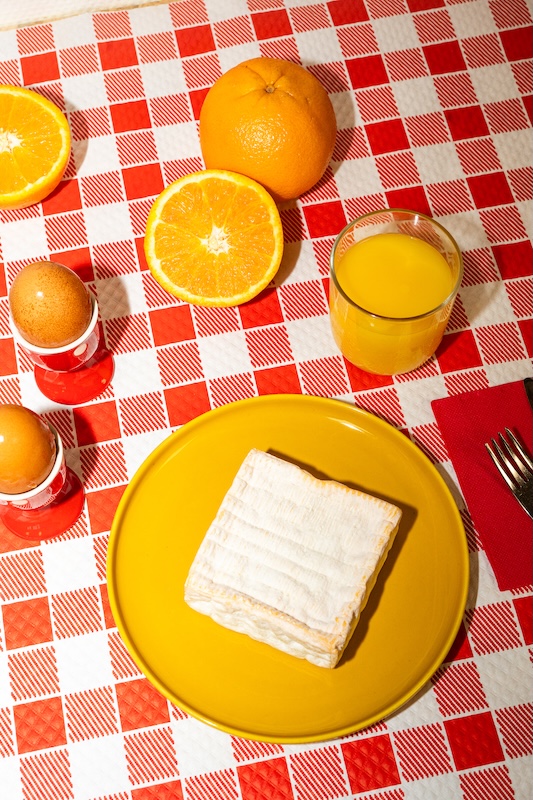
Pont-l’Évêque has its origins in the 12th century, in the Pays d’Auge. According to the reference document provided, it was created by Cistercian monks living west of Caen. It then bore the name Angelot, in reference to an English coin used at the time when the Duke of Normandy was also King of England. Cheese could then serve as a means of exchange, remuneration or even tax.
It then gradually took the name of Pont-l’Évêque, in reference to the town where one of the most important markets in the region was held. In the 19th century, the development of meadows and dairy farming in Lower Normandy encouraged its growth. Farm cheese, it is then made twice a day before being shipped to the Halles of Paris or other French cities thanks to the development of the railway.
Its square shape has become one of its signatures. The document provided dates it back to the 17th century, while the INAO places it in the 18th century: in both cases, this geometry responded to a desire to distinguish Pont-l’Évêque from other Norman cheeses.
What milk is-he does ?
Pont-l’Évêque AOP is made with cow’s milk. It is a soft cheese whose rind is washed and/or brushed during ripening. For a 350g cheese, around 3.5 liters of milk are needed and the cheese must contain at least 45% fat.
Its terroir extends over a vast part of Normandy. The INAO indicates a production area covering more than 1,300 municipalities, notably in Orne, Calvados, Manche and part of Eure. The organization also highlights the importance of the natural conditions of this region, which are particularly favorable to grass production and therefore to dairy farming.
Today, the ODG document indicates that more than 19.5 million liters of milk are used each year to produce Pont-l’Évêque AOP, from 349 farms. More than 2,200 tonnes of cheese are marketed annually and 11 cheese factories produce it, including six farm producers who process the milk from their own cows.
How is Pont-l’Évêque made?
Production begins with milk that can be used raw, thermized or pasteurized, in accordance with the rules of the appellation. It is then renneted to cause it to coagulate. The curd obtained is cut then stirred to eliminate part of the whey.
The curd is then placed in bottomless square molds, which allow it to drain. The cheeses are turned several times before being unmolded on the second day. They are then placed on racks to allow the development of yeasts and molds necessary for the formation of the crust.
Between the second and fifth days, the cheese is salty on the surface. Depending on the character desired by the cheesemaker, its rind can then be washed with brine and/or brushed. These operations can be repeated: they contribute to the formation of the crust and the development of the texture and aromas.
Refining continues in wooden boxes. The cheeses are ready to eat from the 18th or 21st day depending on their size, while it takes about a month and a half to obtain a creamy paste.
What are the different formats of Pont-l’Évêque?
Its shape is square or rectangular, with clearly defined edges and angles. Four formats are sold:
- Half Pont-l’Évêque: approximately 180 g
- Petit Pont-l’Évêque: approximately 220 g
- Pont-l’Évêque: approximately 360 g
- Grand Pont-l’Évêque: approximately 1.2 kg
These formats are defined in the document provided by the ODG.
What does Pont-l’Évêque taste like?
It is undoubtedly during tasting that Pont-l’Évêque reveals all its personality. Its paste, ivory to pale yellow in color, is supple, creamy and melting when sufficiently matured. The rind can range from whitish to reddish depending on the cheese and its maturation.
On the nose and on the palate, the profiles are multiple. The milky and creamy notes can give way to butter, hazelnut, hay, undergrowth or stable. Some Pont-l’Évêque also develop fruity or slightly smoky nuances. The INAO describes its flavor as sweet, with lactic, vegetal, creamy and sometimes slightly smoky aromas.
It is this aromatic palette that allows it to move naturally from the traditional cheese platter to the kitchen.
How to taste Pont-l’Évêque?
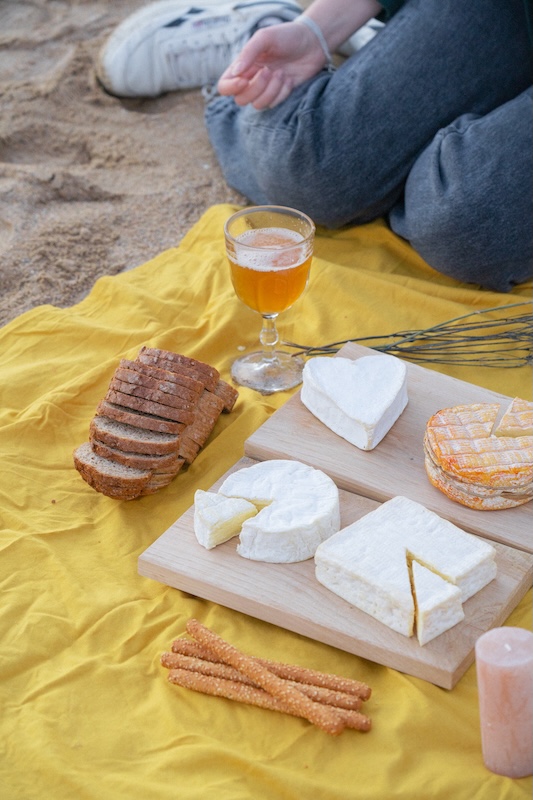
When it comes to cheese, the Pont-l’Évêque benefits from being cut in such a way as to fairly distribute the dough and crust among the guests.
On a platter, he appreciates simple accompaniments which extend his milky and slightly fruity notes: country bread, cereal bread, apples, pears, dried fruits or even a few touches of lightly sweetened jam.
As for drinks, its Norman character naturally calls for regional pairings, particularly with a raw or semi-dry cider. It can also find its place alongside a white wine fresh enough to balance its creaminess.
How to cook Pont-l’Évêque?
Pont-l’Évêque is not satisfied with the cheese platter. Its melting paste makes it a particularly interesting ingredient for generous recipes, where it brings creaminess, character and depth.
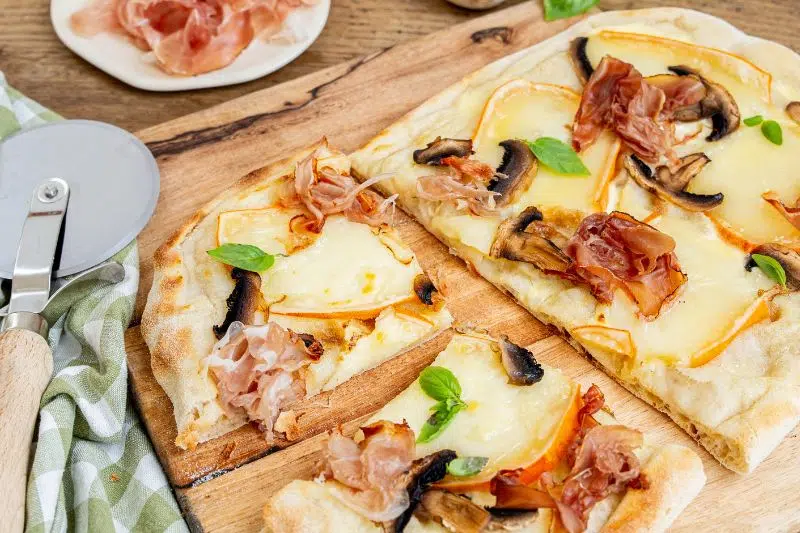
It can therefore simply be roasted in the oven, melted into a preparation, slipped between two slices of bread or combined with ingredients capable of playing with its character: apple, spinach, potato, crusty bread or even cold meats.
Why is Pont-l’Évêque an AOP?
Pont-l’Évêque has benefited from the Protected Designation of Origin (PDO) since 1996. This designation guarantees that the product meets precise specifications and is linked to a specific geographical area and know-how.
Pont-l’Évêque is thus much more than a cheese recognizable by all by its square shape. It tells an ancient Norman story, that of a land of livestock and meadows, of cheese-making know-how passed down over the centuries and of a product which has managed to retain its identity while finding its place in contemporary cuisine.
ALCOHOL ABUSE IS DANGEROUS TO YOUR HEALTH, CONSUME IN MODERATION.