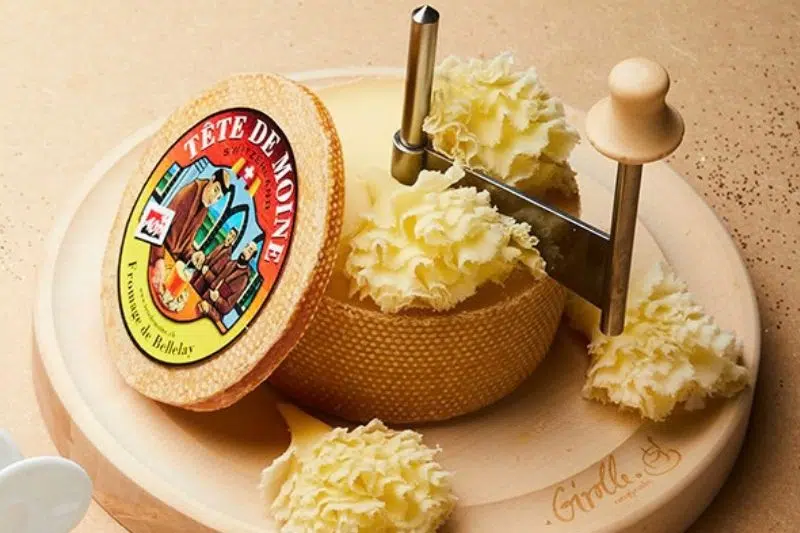
Tête de Moine AOP is a Swiss cheese, made from raw cow’s milk, which reveals all its finesse when scraped into delicate rosettes.
Unmistakable, Tête de Moine AOP is not tasted like other cheeses. This specialty from the Swiss Jura, made with raw mountain milk and matured on spruce boards, is scraped into fine rosettes which instantly unfold its aromas. Under its washed rind, its semi-hard dough then reveals a more airy texture and a taste that is both fine, full-bodied and particularly aromatic. AOP since 2001, this Swiss cheese, also called Fromage de Bellelay, remains closely linked to its terroir and traditional know-how.
The taste of Tête de Moine AOP
It is first of all with its taste that Tête de Moine surprises. Its semi-hard, washed-rind paste develops, over the course of maturing, an aromatic palette which gains depth while retaining a beautiful finesse.
Scraping in rosettes is not just a spectacular gesture: it allows the cheese to open upon contact with air and release more of its aromas. Thinner than a slice, the rosettes offer a particularly delicate sensation in the mouth, with a melting and airy texture.
The Tête de Moine AOP Réserve, matured longer than the Classic, thus presents fuller flavors and a finer paste. The Organic version is manufactured according to the requirements of the different Organic labels.
How is Tête de Moine made?
It all starts with raw mountain milk from cows fed mainly on pasture during the summer, then mainly on hay during the winter. The milk is collected in the appellation region and transported quickly to the cheese factory: its processing must take place a maximum of 24 hours after milking.
In copper vats, the milk is heated to a maximum of 38°C before adding lactic ferments, then natural rennet. After coagulation, the curds are cut, heated between 46 and 53°C and stirred for a long time to obtain the right grain. It is then molded, pressed and turned to remove the whey.
The wheels are then immersed for at least 12 hours in brine. Refining then begins, for a minimum of 75 days, in the appellation zone. On their spruce boards, in cellars at around 13-14°C and 90% humidity, the cheeses are regularly turned and brushed with salt water and selected ferments.
Once a month, each production is subjected to a real tasting control: external appearance, openings of the dough, texture, color, scrapability, smell and taste are examined. Cheeses that do not meet the criteria cannot bear the Tête de Moine AOP designation.
Why is she being beaten?
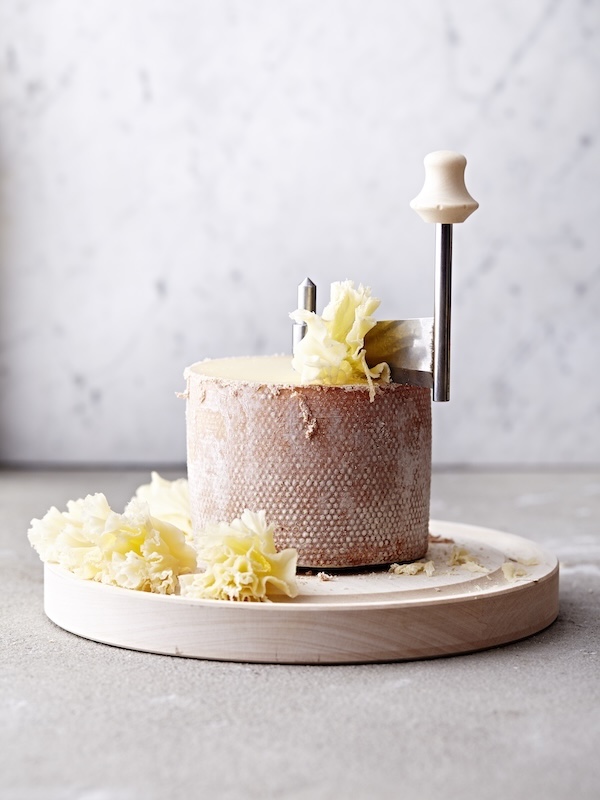
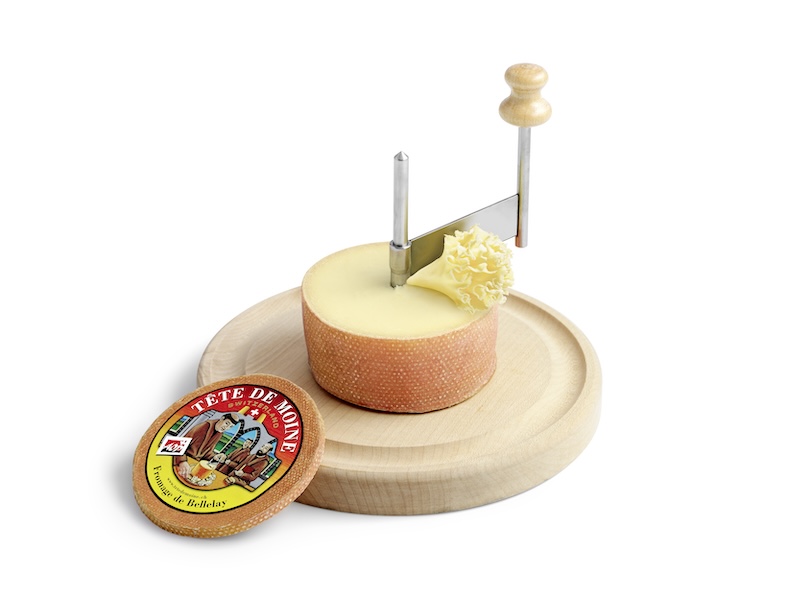
It’s the gesture that makes it unique. The Tête de Moine cannot be cut: it is scraped.
Traditionally, cheese was scraped vertically with a knife. Today, Girolle® allows you to form pretty, regular rosettes. By scraping the surface of the wheel, we increase its contact surface with the air and bring out all the aromatic richness of the cheese.
The Tête de Moine is ideally scraped straight out of the refrigerator. The rosettes can then be enjoyed immediately, as an aperitif, on a cheese platter, as an accompaniment to a dessert or simply for a gourmet break.
Classic, Reserve and Organic, the differences
Tête de Moine AOP exists in three varieties.
- Tête de Moine AOP Classic : the classic expression of this Jura cheese, with its minimum maturation of 75 days and its characteristic balance.
- Tête de Moine AOP Reserve : its longer maturation (4 months) gives it more character and a finer paste.
- Organic AOP Moine’s Head : it respects, in addition to the AOP specifications, the requirements of the various organic labels. Like the Classic, it is matured for a minimum of 75 days.
Regardless of the version chosen, only cheeses meeting the very strict requirements of the AOP and having passed quality controls can bear the name Tête de Moine AOP, Fromage de Bellelay.
A naturally lactose-free cheese
Like other cheeses, Tête de Moine is a concentrated form of milk. It provides proteins, calcium and magnesium, as well as vitamin A and certain B vitamins.
Tête de Moine AOP is also naturally gluten-free and lactose-free. During manufacturing, most of the lactose is found in the whey and the remainder is eliminated during refining, where it is transformed into lactic acid.
It is manufactured without additives: its composition is based on milk from cows fed without ensiled feed, natural rennet, lactic cultures and salt.
Can we eat its crust?
The rind, or morge, forms naturally during ripening. It is regularly brushed with salt water and selected ferments, without colorings or chemical additives for surface treatment. When scraping, the crust naturally crumbles around the rosettes. For a more pleasant tasting experience, it is therefore preferable to decrust the upper part before scraping the wheel.
A thin white film can sometimes appear on the crust: this is a natural yeast called powdery mildew, which does not present any danger to the consumer.
How to store it?
Tête de Moine can be stored in the refrigerator, under its cover. This protects the wheel from drying out, preserves its aromas and allows it to be kept ready to be scraped. To make the most of its texture and aroma, scraping is ideally carried out directly after taking it out of the refrigerator.
What to taste Tête de Moine with?
On a cheese platter, it brings a spectacular and refined touch. As an aperitif, the rosettes are sufficient on their own but also pair well with bread, dried fruits or more vegetal flavors.
It can also accompany a dessert or be included in savory preparations. Its rosette format allows it to be added at the last moment, so that it retains all its finesse.
What to cook with Tête de Moine?
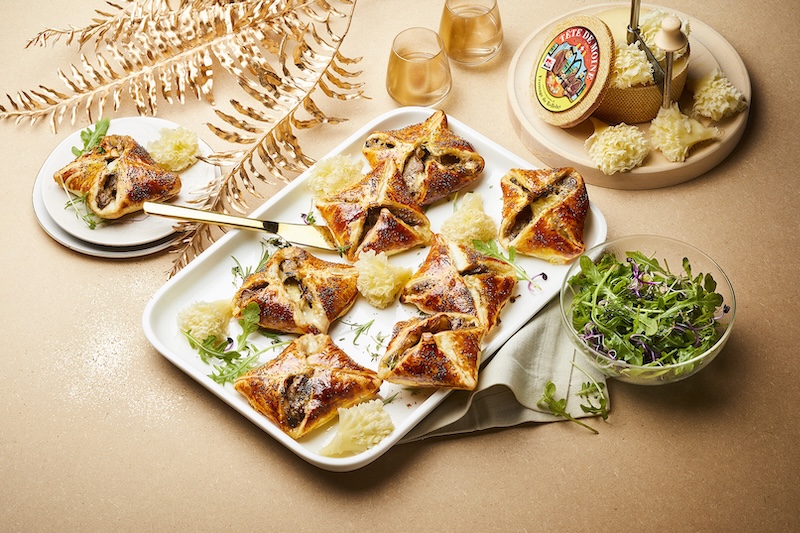
La Tête de Moine is definitely not limited to the cheese platter. It brings its character to many recipes: it slips into trout flutesof the mini-kouglofsof the mini burgersof the Indian breads with caraway seeds or even in forest puffs. She also accompanies scrambled eggs with truffle and blends into a corn soup.
It can also bring an original cheese touch to a rougail sausageto Mediterranean roasted eggplant and naturally finds its place as an aperitif on a transalpine cheese platter. Its rosettes are particularly elegant placed on individual preparations, such as deviled eggs or on toast.
A story almost as astonishing as his gesture
Tête de Moine finds its roots at Bellelay Abbey, in the Swiss Jura, where the cheese was already mentioned in documents dating back to the 12th century. The name “Tête de Moine” appeared at the end of the 18th century. The protected designation of origin was obtained in 2001, establishing the link between the cheese, its terroir and its manufacturing method.
Since then, an invention has definitively changed its tasting: the Girolle, developed in the 80s, which popularized the spectacular rosette scraping.
Tête de Moine is much more than a semi-hard cheese. It is a local cheese where the act of tasting is an integral part of the taste. Scraped just before savoring it, its paste unfolds into fine gourmet flowers, as beautiful to look at as they are delicate to taste.
Cover visual © La Photography