
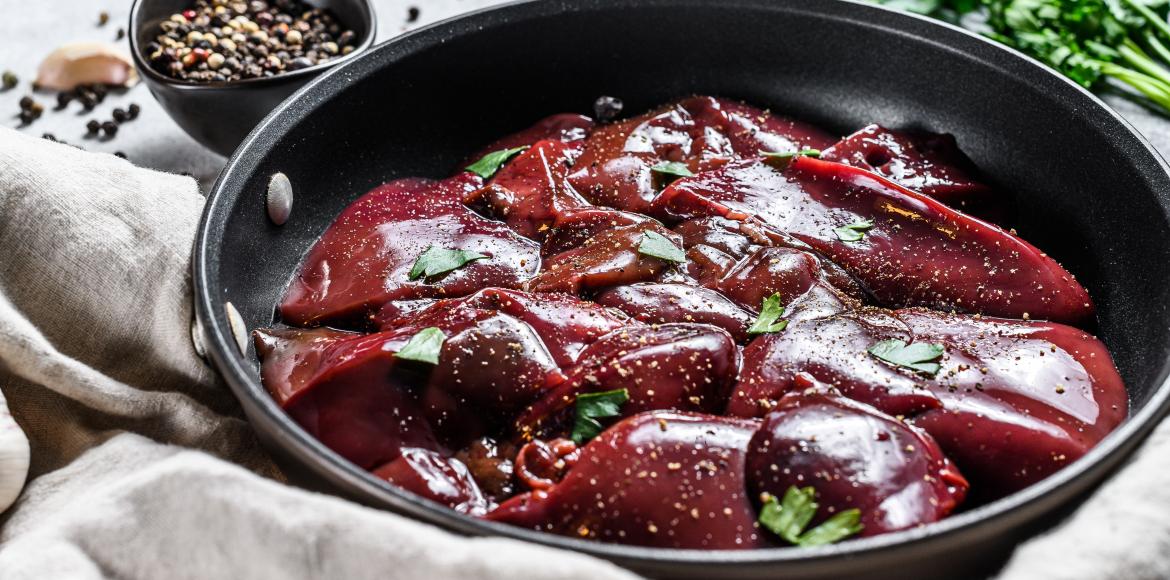
Today shunned by consumers, offal is nevertheless a particularly interesting source of nutrients. Explanations with David Nicolas, entrepreneur and author of the book Omnivorous.
On butchers’ stalls and supermarket shelves, you will mainly find pieces made from animal muscles. Liver, kidneys, heart: they are consumed less and less by the French. According to David Nicolas, their consumption has even been divided by three in fifty years in France. “We have therefore removed from our plate the most nutritionally dense category of food that exists on earth”he regrets in his book Omnivorous.
Here are three good reasons to rehabilitate them.
The liver: an exceptional concentrate of nutrients
Take the example of the liver. It concentrates certain micronutrients in significant quantities, notably copper, zinc, selenium, vitamins A, B9 and B12. According to data from Anses (CIQUAL), 100 g of cooked veal liver provides:
- 19 g of proteinsabout 1/3 less than a steak;
- 3 times the recommended daily dose of vitamin A (retinol)because the liver stores this important vitamin for vision and the skin;
- more than 10 times the recommended daily dose in vitamins B12 and B3 : the liver is one of the richest foods that can be found for these two vitamins;
- more than 100% of the recommended intakes in vitamin B9 (folate) and about half of the recommended intakes for vitamin B6 ;
- 4 times the recommended intake in copper and more than 10% of contributions for the iron ;
- antioxidant minerals : approximately half of the daily intake of zinc and selenium.
For this reason, and because liver steak is not always popular with consumers, the company Fiercecreated by David Nicolas, incorporates it into its minced steaks.
A recipe: Stir-fried chicken livers with spices
However, the liver is also an organ that can store contaminants, hence the need to know its origin and have guarantees of its quality.
Formerly refined dishes
Offal suffers from a bad image. A cellophane-wrapped steak has a more acceptable appearance than offal of brains, hearts or kidneys. But it was not always like this. For example, tongue has long been considered a noble delicacy, served on special occasions. Braised beef tongue has long been a classic of festive meals, just like calf’s head or sweetbreads, recalls David Nicolas.
To maximize the value of the animal
If we only use meat from the muscles, then a part of the animal that could have been valued is given to the animals, or even simply destroyed or thrown away. Preserving and consuming offal can also be considered as an approach that is more respectful of animal resources. According to David Nicolas, only 42% of a beef produces boneless cuts, corresponding to what we call “meat”. “In a conventional circuit, the recovery yield barely reaches 60%. The remaining 40% is destroyed, exported to China or processed into pet foodhe notes. We prefer to feed our dogs beef liver rather than giving it to our children. »
It is also paying homage to the sacrifice of the animal to use its carcass to the maximum. “I am convinced that the breeder’s responsibility is to offer the best quality of life to his animals, and that ours is to honor their sacrifice by valuing each piece. »
Finally, the valorization of offal can bring additional income to the meat industry. Valuing the whole animal is therefore not only an ethical question, but a choice that can help build an economically viable model for breeders.