
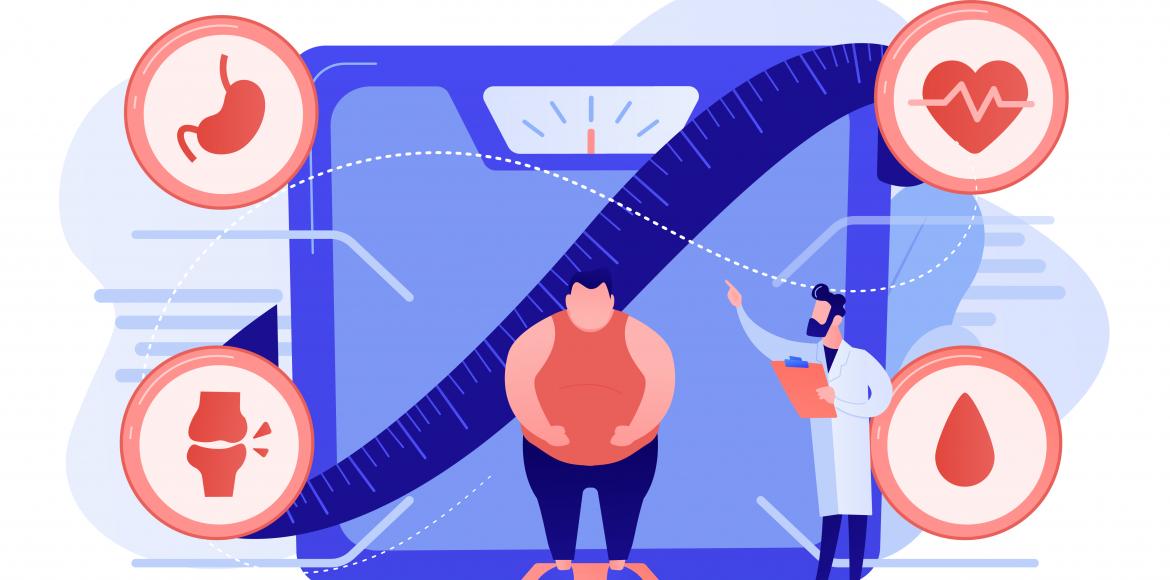
After the age of 50, having a high waistline and low vitamin D levels more than doubles the risk of dying within six years, according to a study of 5,500 people.
Obesity represents a health risk. But this risk would be even higher if it is associated with a vitamin D deficiency. This is shown by a study recently published in the journal Diabetes, Obesity and Metabolism (1).
Researchers from the Federal University of São Carlos (Brazil), associated with University College London, relied on data from the English ELSA cohort (English Longitudinal Study of Aging), a study on aging. They followed 5,520 people aged 50 and over for six years.
Two criteria were crossed:
- abdominal obesity, defined by a waist circumference greater than 102 cm in men and 88 cm in women;
- vitamin D status, defined by the blood level of 25(OH)D: a deficiency corresponded to a level below 30 nmol/L (12 ng/mL).
Compared to participants who had neither of these two factors (neither abdominal obesity nor vitamin D deficiency), the risk of death during follow-up was increased:
- for abdominal obesity alone: + 47%;
- for vitamin D deficiency alone: + 91%;
- for both at the same time: + 123%.
In other words, the combination of the two more than doubles the risk of dying within six years. “This is why monitoring vitamin D levels and treating excess abdominal fat are essential measures to prevent premature deaths, especially after age 50”concludes Tiago Silva Alexandre, professor at the Department of Gerontology at the University of São Carlos, who coordinated the study.
Read: 7 Common Foods Sources of Vitamin D
Belly fat and vitamin D: a vicious circle
Vitamin D is fat soluble. In people who have a lot of abdominal fat, some of it is stored in fat cells, instead of circulating in the blood. In addition, obese people express less of the enzymes necessary for its metabolism, which reduces its bioavailability. “Abdominal obesity reduces the level of vitamin D in the blood, and this deficiency weakens the immune system, which worsens chronic inflammation caused by excess fat and significantly increases the risk of mortality”affirms Professor Alexandre in a press release (2). With age comes inflammaging, the background inflammation that accompanies aging. This harmful combination could promote cardiovascular and metabolic diseases as well as muscle wasting.
Abdominal obesity reduces the level of vitamin D in the blood
An association, not proof of causation
This is an observational study: it shows an association, not a cause and effect link. Low vitamin D levels can also reflect poor general health, less outing in the sun and reduced physical activity.
How to supplement with vitamin D
Vitamin D deficiency is widespread in France. According to the Esteban study (3), only one in four adults reaches a satisfactory blood level (more than 30 ng/mL). In mainland France, the sun does not produce enough vitamin D in winter, and the reserves built up in summer only last two to three months. So fall is a good time to start supplementing.
In France, blood testing is only reimbursed in specific cases, for example in elderly people who fall repeatedly. ANSES considers an intake of 15 mcg per day sufficient for adults. With theEndocrine Societylanutrition.fr recommends at least 1,000 IU per day (25 mcg; 1 mcg = 40 IU).
People who are overweight or obese need higher doses to achieve the same blood levels, since some of the vitamin D remains trapped in fatty tissue. Researchers recommend a dose 1.5 times higher in cases of overweight and 2 to 3 times higher in cases of obesity compared to people of normal weight. Based on 1,000 IU, this gives approximately 1,500 IU per day for overweight and 2,000 to 3,000 IU per day for obesity (4).
Prefer small, regular doses: daily or weekly intake better mimics the natural production by the skin. It has shown itself to be more interesting on a clinical level, particularly for preventing falls and fractures. Ampoules dosed at 50,000 or 100,000 IU remain practical for people who already take a lot of medication, but massive single doses of 300,000 to 500,000 IU should be avoided (5).