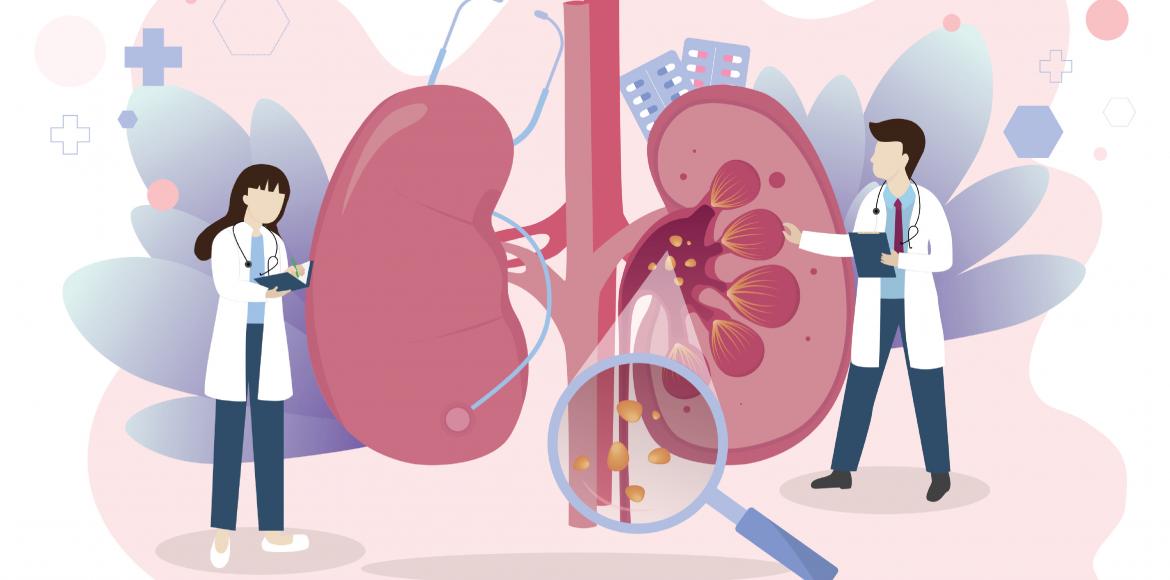
A team from the University of California Los Angeles has demonstrated a new mechanism in the formation of kidney stones based on calcium oxalate: living bacteria are integrated into their structure.
Calcium oxalate kidney stones are not purely chemical in origin
For a long time, it was considered that kidney stones were formed exclusively by chemical and physical processes. But researchers from the University of California at Los Angeles (UCLA) have just shaken up this model by publishing their discovery in the journal PNAS (1).
By examining calcium oxalate stones under electron microscopy and fluorescence, researchers detected the presence of live bacteria as well as biofilms (organized layers of bacteria) embedded in the stones. Calcium oxalate represents almost 80% of kidney stones, and this type of stone has never previously been associated with the presence of bacteria.
“This advance challenges the long-held assumption that stones develop solely through chemical and physical processes, and instead shows that bacteria can reside inside stones and actively contribute to their formationsaid in a press release (2) Dr. Kymora Scotland, co-author of the study. By unveiling this new mechanism, the study opens the way to new therapeutic strategies targeting the microbial environment of kidney stones. »
Take care of your intestinal flora and acid-base balance to prevent stones
Although this work is still preliminary, it joins growing scientific interest in the role of the microbiota in kidney health. Studies have already shown that certain intestinal bacteria, such as Oxalobacter formigenesparticipate in the breakdown of oxalates in the digestive tract, thus reducing their passage into the urine and the risk of crystallization (3).
“These findings could also help explain the links between recurrent UTIs and recurrent kidney stone formation,” adds Kymora Scotland.
In his book Bye Bye kidney stonesSandra Gressard, dietician-nutritionist specializing in nephrology, recalls that diet plays a central role in preventing recurrences. She particularly emphasizes the importance of acid-base balance: “The body’s acid-base balance depends largely on diet, and in particular on the mineral composition of the foods we ingest. »
Calcium oxalate stones are preferentially formed in an acidic urinary environment: a diet rich in vegetables, fresh fruits and legumes, which have a negative PRAL index (alkalizing), helps to maintain a favorable urinary pH, around 6. The PRAL index indicates the acidic or alkaline nature of a food.
- Examples of acidifying foodswith a positive PRAL index: meat, fish, eggs, cold meats, shellfish, dairy products, cereal products.
- Examples of alkalizing foodswith a negative PRAL index: vegetables and aromatic herbs, starchy foods such as tubers (potatoes), certain legumes, fresh and dried fruits, and certain oilseeds.
To find out more: Bye Bye kidney stones
-
References
-
Historical
-
Schmidt et al. Intercalated bacterial biofilms are intrinsic internal components of calcium-based kidney stones. PNAS. February 26, 2026.
-
UCLA. Researchers discover a previously unknown bacterial component in kidney stone formation. January 2026.
-
Duncan et al. Oxalobacter formigenes and Its Potential Role in Human Health. Appl Environ Microbiol. 2002.
- 03/24/2026