
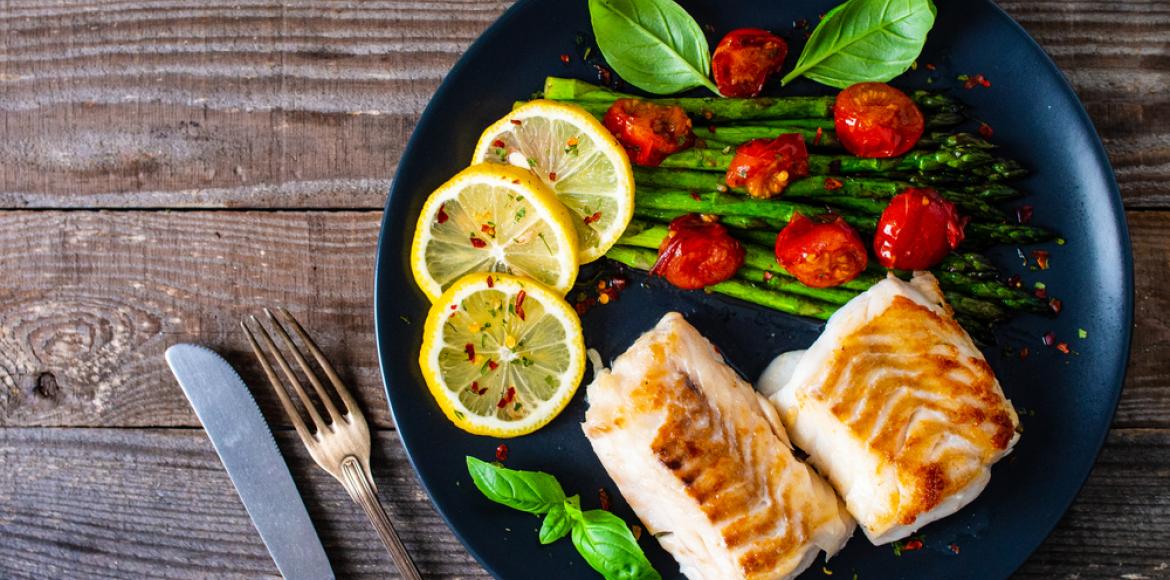
Taking into account the benefit/risk ratio, ANSES recommends eating fish twice a week. LaNutrition.fr recommends 2 to 3 servings.
The consumption of fish and seafood today represents a dilemma: on the one hand it provides a supply of omega-3 fatty acids, essential for health. Thus, EPA (eicosapentaenoic acid) and DHA (docosahexaenoic acid) promote cardiovascular well-being.
Consult our file on omega-3
On the other hand, it exposes people to contaminants like PCBs and mercury.
Read: The most contaminated fish and those that are less contaminated (subscribers)
Recommendations regarding fish consumption
In 2013, ANSES (national agency for food, environmental and occupational health safety) issued an opinion concerning the consumption of fishery products: while advising to eat fish twice a week, it lists the species to avoid due to the risk of contamination (1). The agency recommends sticking to two servings of fish per week. One of two servings should come from fish rich in EPA and DHA: salmon, sardines, mackerel, herring, smoked trout. Both the species and their origin must be diversified.
On the basis of recent work which shows that the benefit/risk balance nevertheless leans in favor of omega-3 from fish (2), LaNutrition.fr recommends for omnivores 2 to 3 servings of fish per weekincluding one in a species rich in omega-3, and 2 servings for pregnant women and children. Vegetarians can look to other sources of long-chain omega-3 such as eggs from flax-fed poultry. Without forgetting that we have the enzymes which normally allow us to transform the alpha-linolenic acid from flax seeds, walnuts or rapeseed oil into EPA and DHA (provided we do not consume too much omega-6). You should also know that moderate wine consumption is associated with an increase in EPA level, a phenomenon highlighted by Michel de Lorgeril and his team in 2008 (3).
Due to the risks of contamination, ANSES indicates that certain species must be limited: eel, barbel, bream, carp, catfish, monkfish (monkfish), sea bass (sea bass), bonito, eel, emperor, grenadier, halibut, pike, sea bream, skate, sabrefish, tuna. Others should even be avoided because of the risk linked to mercury: swordfish, marlin, siki, shark and lamprey.
ANSES also reminds you of some basic rules to apply at home to limit the microbiological risk: respect the cold chain, storage times, freeze fish that you want to eat raw for 7 days and eat shellfish within two hours of taking them out of the refrigerator. Raw or undercooked fish is not recommended for fragile people such as pregnant women, the elderly or immunocompromised people.
Finally, you should avoid consuming shellfish collected anywhere: choose those that come from an authorized and controlled area. Shellfish that have grown near wastewater can transmit human diseases, such as hepatitis A!
Read: The best way to eat fish and seafood (subscribers)
The Best Way to Eat Fish During Pregnancy
During pregnancy, women may question their consumption of seafood: on the one hand, fish is rich in nutrients essential to the development of the baby’s brain such as polyunsaturated fatty acids, selenium, iodine, vitamin D; and on the other, it provides methylmercury, a neurotoxicant. This is why many expectant mothers limit their fish consumption during their pregnancy.
A study based on data from a cohort of children born near a port in Massachusetts helped clarify the advice to be given to pregnant women (4). At the age of eight, 361 children born between 1993 and 1998 took exams to assess their neurological development, including tests of IQ, language, memory and attention. Researchers measured mercury exposure during the third trimester of pregnancy using hair samples taken from the mothers. They also completed a questionnaire about their diet and the authors estimated average mercury levels by type of fish.
Using this model, they found that the relationship between fish consumption during pregnancy and child neurodevelopment varied depending on average mercury levels in fish: consumption of fish with low mercury content was beneficial, while consumption of fish with high mercury content was detrimental.
Among the fish most contaminated with mercury are swordfish, shark, bonito, halibut, sea bass and tuna.
LaNutrition.fr has made detailed recommendations in the book The Best way to eat (read an extract HERE >>)
-
References
-
Historical
-
ANSES. Opinion from the National Agency for Food, Environmental and Occupational Health Safety relating to recommendations on the benefits and risks linked to the consumption of fishery products as part of the updating of the PNNS nutritional benchmarks. June 3, 2013.
-
Maria Wennberg, Ulf Strömberg, Ingvar A Bergdahl, Jan-Håkan Jansson, Jussi Kauhanen, Margareta Norberg, Jukka T Salonen, Staffan Skerfving, Tomi-Pekka Tuomainen, Bengt Vessby, Jyrki K Virtanen. Myocardial infarction in relation to mercury and fatty acids from fish: a risk-benefit analysis based on pooled Finnish and Swedish data in men. Am J Clin Nutr 2012. ajcn.033795; First published online August 15, 2012. doi:10.3945/ajcn.111.033795.
-
De Lorgeril et al. Interactions of wine drinking with omega-3 fatty acids in patients with coronary heart disease: a fish-like effect of moderate wine drinking. Am Heart J. 2008.
-
Thurston et al. A Novel Approach to Assessing the Joint Effects of Mercury and Fish Consumption on Neurodevelopment in the New Bedford Cohort. American Journal of Epidemiology. June 28, 2024.
-
Current version
09/19/2024 - on 07/08/2024
- on 07/12/2013