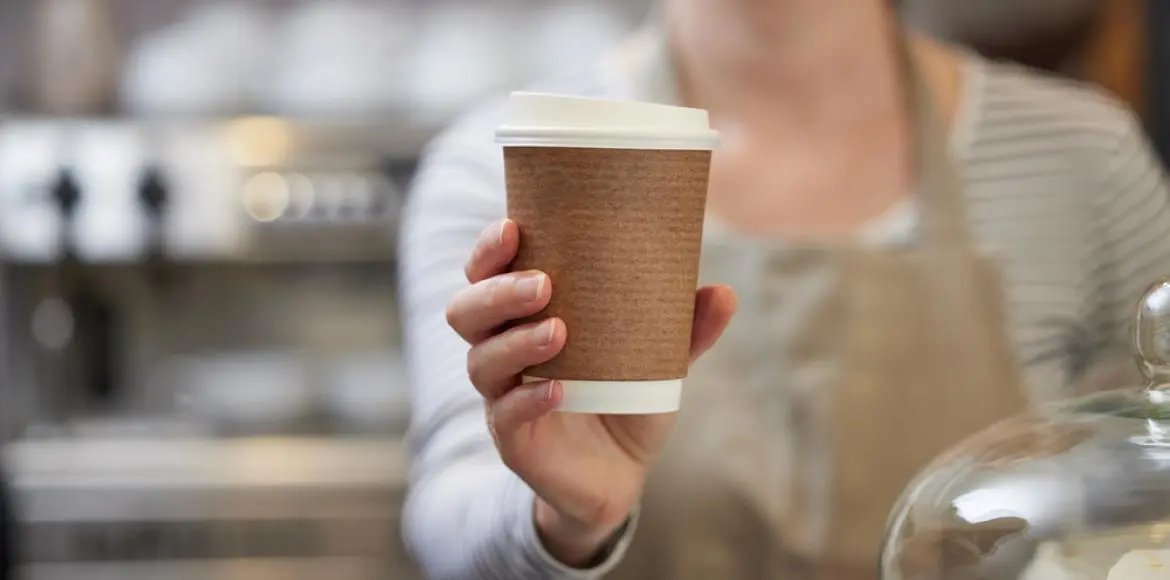
Every day, millions of coffees are consumed in disposable cups, containers that expose consumers to microplastics, according to a recent study.
Drinking takeaway coffee increases exposure to microplastics
Australian researchers analyzed the behavior of different types of cups used for takeaway drinks, including all-plastic cups and paper cups coated with a thin layer of plastic. “My colleagues and I first conducted a meta-analysis – a statistical synthesis of existing research – by analyzing data from 30 peer-reviewed studiesexplains Dr Xiangyu Liu, from Griffith University in Australia (1). We examined how common plastics such as polyethylene and polypropylene behave under different conditions. » According to their results published in Journal of Hazardous Materials: Plasticsthese containers release microplastics into the liquids they contain, especially when the drink is hot (2).
But one factor stood out: temperature. When the hot drink is poured into a plastic cup, the heat softens the material slightly, which encourages the release of microscopic fragments. The researchers observed that, in a plastic cup, switching from a cold drink to a hot drink increased the amount of microplastics released by around 33%.
According to their estimates, a person drinking a 300 mL coffee from a polyethylene cup every day could ingest around 363,000 microplastic particles per year. Plastic-coated paper cups seem to release slightly less than all-plastic cups, but they are not exempt.
How to explain it? “Using high-resolution imaging, we looked at the inner walls of these cups and found that the all-plastic cups had much rougher surfaces, with many dips and bumps, than the plastic-coated paper cups.said Dr. Xiangyu Liu. This rougher texture facilitates the detachment of particles. »
Microplastics are now everywhere in our food
These results are part of a broader context: microplastics are now omnipresent in the environment. It is found in the air, water, soil and many foods, as Professor Jean Demarquoy explains in his book Microplastics – our health in danger. This pollution has become almost inevitable. According to the WWF, we could ingest up to 5 grams of microplastics each week, the equivalent of the weight of a bank card.
These particles come from multiple sources: food packaging, bottles, synthetic textiles and even tires. Broken into tiny particles, plastics can contaminate food and drinks. “Microplastics have been detected in a wide variety of foods and drinks: bottled water, seafood, table salt, dairy products and processed foods, said Jean Demarquoy. Several studies have shown that some brands of bottled water contain up to 10,000 plastic particles per liter, on average twice as much as tap water. »
The health effects remain poorly understood. However, some studies suggest that microplastics could cause inflammatory reactions or carry potentially toxic chemicals.
Read: Microplastics promote antibiotic resistance
How to reduce your daily exposure to microplastics
Faced with this diffuse pollution, it is difficult to completely eliminate exposure to microplastics. But a few simple actions can reduce it.
The first measure is to avoid plastic containers for hot drinks: preferably use reusable cups or tumblers made of glass, ceramic or stainless steel, which do not release microplastics. In his book, Jean Demarquoy also suggests other strategies, such as favoring inert materials for cooking or preserving food, because the kitchen is a “risky place”: “The kitchen is a place of life, where we cook, where we exchange, get together, but also a space where plastics are omnipresent: utensils, storage containers, cling film, bottles, bags, packaging… These familiar objects are found daily in contact with heat, humidity, food. Exactly the conditions that favor the migration of micro- and nanoplastics. »
To find out more: Microplastics – our health in danger
Read an EXTRACT>>
-
References
-
Historical
-
Liu. Takeaway coffee cups release thousands of microplastic particles. The Conversation. 2026.
-
Liu et al. Release of microplastics from commonly used plastic containers: Combined meta-analysis and case study. Journal of Hazardous Materials: Plastics. February 2026.
-
Current version
on 03/09/2026 - on 03/06/2026