
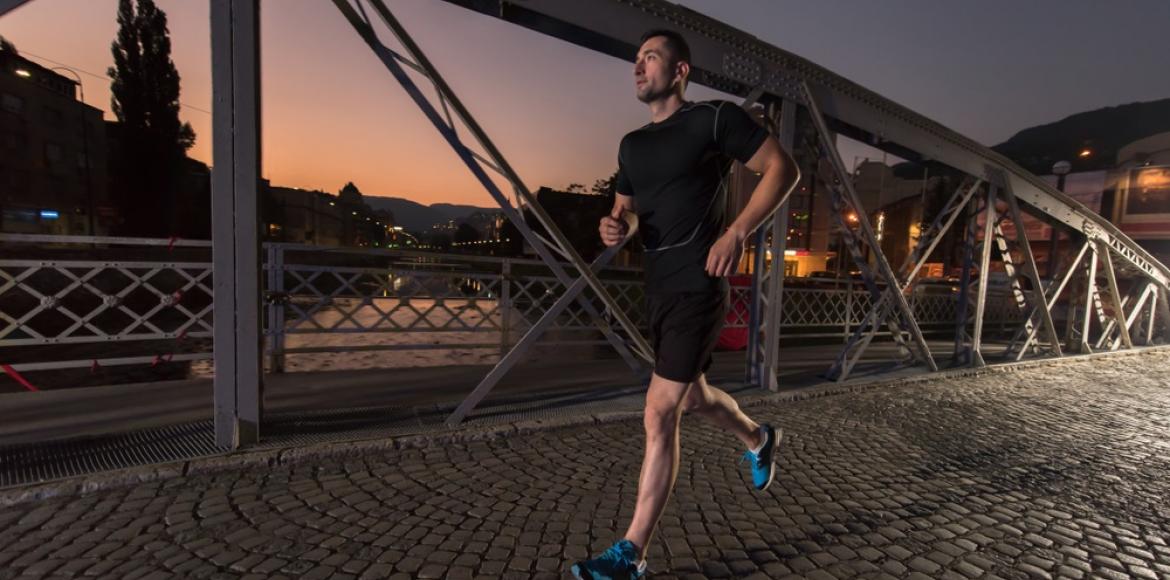
The effects of sport on the body would not be the same depending on the time at which it is practiced. Training in accordance with your personal biological clock would amplify the benefits of exercise.
The role of the circadian rhythm in physical activity
We know that the circadian rhythm plays an important role in our health. Many parameters (temperature, blood pressure, metabolism, etc.) vary depending on the time of day. They are dependent on the internal biological clock. We also know that thephysical activity helps improve metabolic health.
Since the biological clock plays an essential role in regulating muscle metabolism, one may wonder at what time of day it is best to exercise physical.
Exercising in the morning or evening: new study in humans
A recent randomized controlled trial provides some answers. 150 adults aged 40 to 60, all carrying at least one cardiovascular risk factor, were divided according to their chronotype (their natural tendency to be more of a morning person or more of an evening person) and randomly assigned to train either in accordance with their chronotype or out of sync. The 40 min sessions were held in the morning (8 a.m.–11 a.m.) or in the evening (6 p.m.–9 p.m.). There were 5 sessions per week of moderate intensity aerobic exercise, for 12 weeks. The results appeared in the journal Open Heart.
Participants whose training schedule matched their chronotype obtained better improvements in all markers measured: blood pressure, aerobic capacity, blood sugar, cholesterol and sleep quality.
Two important nuances are worth noting. First, even participants who trained at the “wrong” time made progress: the sport remained beneficial whatever the time. Then, the study focused only on frank chronotypes; However, intermediate chronotypes represent around 60% of the adult population, and for them the time is probably less decisive.
Test: Are you more of a morning person or an evening person?
Researchers have developed a scientifically validated questionnaire, the MEQ (Morningness-Eveningness Questionnaire), to determine its chronotype. Here are some representative questions:
- What time would you get up if you had complete freedom to organize your day?
- What time would you go to bed if you had complete freedom to organize your evening?
- How do you feel during the first half hour after waking up? (very tired / rather tired / rather fit / very fit)
- At what time of day do you expect to reach your peak form?
- If you had to do 2 hours of intense physical activity, what time would you schedule it?
The complete questionnaire (19 questions) allows you to place yourself on a spectrum ranging from “definitely in the evening” to “definitely in the morning”. It is available online.
What research already showed about the best time to train
A previous study published in Cell Metabolismcarried out on animal models, had already highlighted differences depending on the time of practice.
The study was carried out on mice. Some did physical exercise, others remained sedentary (control group). The researchers looked at the effect of sport on muscle cell metabolism at different times of the day (morning and evening). The researchers obtained better results for the parameters measured after physical exercise performed in the morning. This could be explained by a mechanism involving the HIF1-alpha protein which directly regulates the circadian clock.
Exercising in the morning makes muscle cells more efficient and better able to metabolize sugar and fats, which may be beneficial for people who are overweight or have type 2 diabetes. Evening exerciseon the other hand, increases overall energy expenditure for a long period.
These effects are likely controlled by the body’s circadian clock. However, researchers cannot conclude on the best time to exercise.
Beyond chronotype: other factors to take into account
Chronotype is not the only parameter that influences the quality of a workout. In an article published on The ConversationPaul Hough (University of Westminster) identifies several other factors in his analysis.
The role of temperature: the benefits of the afternoon
Body temperature plays an important role: it reaches its peak in the afternoon, regardless of chronotype, which improves muscle function. Strength, speed and coordination are therefore generally better at this time, making the afternoon a privileged window for bodybuilding and technical training.
The benefits of training whatever the time
The training habit also counts: by training regularly at the same time, the body adapts to it. Thus, even a night owl systematically practicing morning sport can end up performing well there.
The benefits of good sleep on performance
Finally, the quality of sleep the previous night is an important factor. As Paul Hough explains, “If you didn’t sleep well the night before, research suggests it’s better to exercise earlier in the day, regardless of your chronotype. In the evening, increasing sleep pressure makes exercise more difficult and can impair performance. » He also recommends leaving at least two hours between the end of a session and going to bed, especially if the intensity is high.
In conclusion
As Paul Hough summarizes, “There is no universal best time to exercise. Adapting the training schedule to your chronotype can help you train more effectively and reap better health benefits. But any exercise is better than none, no matter the time. » The priority remains to find a niche that we can hold over the long term. The best thing to do is to experiment and see what works best for you.
To go further, read: The secrets of the biological clock
-
Historical
-
Current version
on 06/08/2026 - on 06/17/2019