
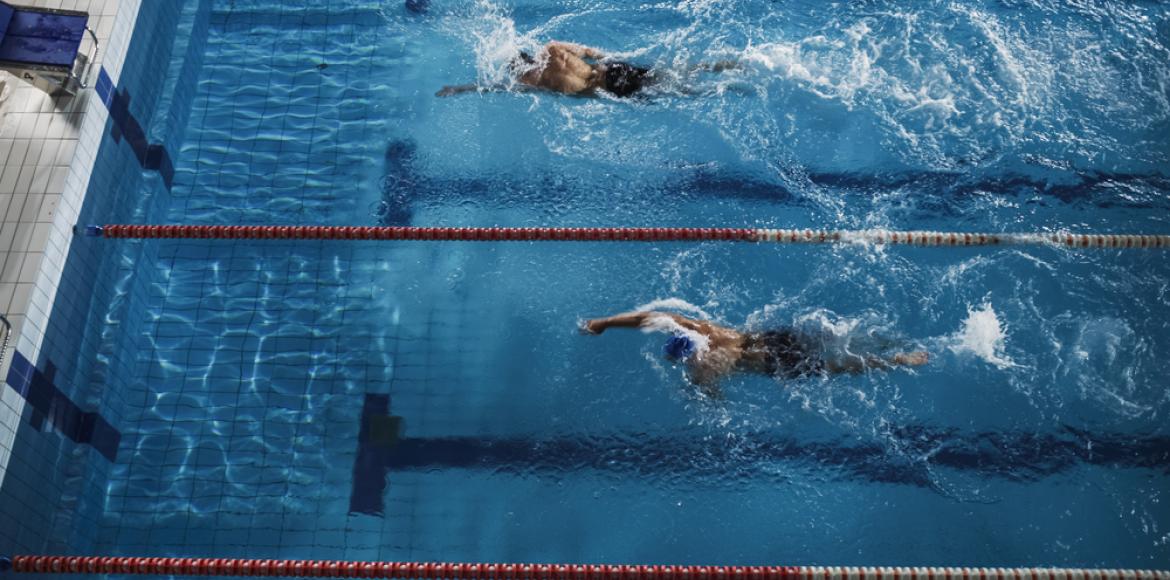
In an interview, the Olympic champion explained that he uses cardiac coherence in his mental preparation. A study has highlighted the potential of this breathing technique to help high-level athletes manage the stress of major competitions.
Cardiac coherence is an anti-stress breathing method that can be of great benefit to elite athletes who encounter, during competitions, very stressful situations that can alter their performance. Léon Marchand, recent gold medalist at the Paris 2024 Olympic Games, experienced it. “Now I am no longer afraid of failure,” he said in an interview with Brut (see video below).
The young swimmer benefited from mental preparation which allowed him to overcome his fears. “Before he was afraid of doing wrong”affirms his mental trainer, Thomas Sammut. “We worked on it and I think it will be, in one or two years, the world number 1. » Bet successful. The interview was conducted two years before the Olympics.
The mental preparation followed by the Olympic champion included breathing exercises with cardiac coherence. The swimmer chose a keyword, pleasure, which gives him motivation. Why this choice? “When I’m having fun I can do whatever I want, I have no limits. » The swimmer repeats this key word in his head, for example before a race. “It allows me to feel that energy within myself, to know who I am before a race and to unleash my full potential. »
Before following this mental preparation, the swimmer said that he did not feel legitimate if he did not bring home a medal. “With Thomas, we opened doors. It allowed us to rediscover myself and know how I work. » Now in a final, he seeks to know how far he can go. “It’s an extra help, it allowed me to grow as a human. »
Benefits that have been the subject of a scientific publication
The benefits of cardiac coherence for athletes have also been studied in a publication published in the journal Journal of Sport Psychology in Action. This study carried out on a high-level athlete participating in the Olympic Games showed that cardiac coherence improves the psychophysiological response to stress.
Indeed, cardiac coherence increases heart rate variability. However, significant variations in heart rate are synonymous with the balance and adaptability of the autonomic nervous system, either to prepare the body to respond to stress, or to slow down the body’s functions in order to promote relaxation.
By learning to breathe 6 times per minute and continuing the exercise for at least 5 minutes, at least 3 times per day, athletes are then able to use this breathing in competition or when they feel under pressure.
David Shearer, professor of sports psychology, is one of the authors of this study. In particular, he gives the example of an athlete who during a competition made an error which had an impact on his performance throughout the competition. The ability to respond positively to anxiety and mistakes reflects the level of control the athlete feels they have over a given situation and their own reaction.
How to practice cardiac coherence
A daily practice of cardiac coherence improves the ability to respond to stress in times of pressure. This method is as simple as the air we breathe, accessible to everyone, free of charge. You can simply use a timer at the beginning to be sure to breathe 6 times per minute (i.e. one inhalation and one exhalation over 10 seconds). There are also free apps to practice this method.
Cardiac coherence is also used in very diverse situations: in class, against sleep disorders, to soothe chronic pain and manage addictions, particularly food addictions.
-
References
-
Historical
-
Mike J. Gross, Ross Hall, Joy D. Bringer, Christian J. Cook, Liam P. Kilduff & David A. Shearer (2017): Resonant frequency training in elite sport: A case study example, Journal of Sport Psychology in Action, DOI: 10.1080/21520704.2017.1287797
-
Current version
on 03/13/2026 - 07/30/2024
- 10/12/2019