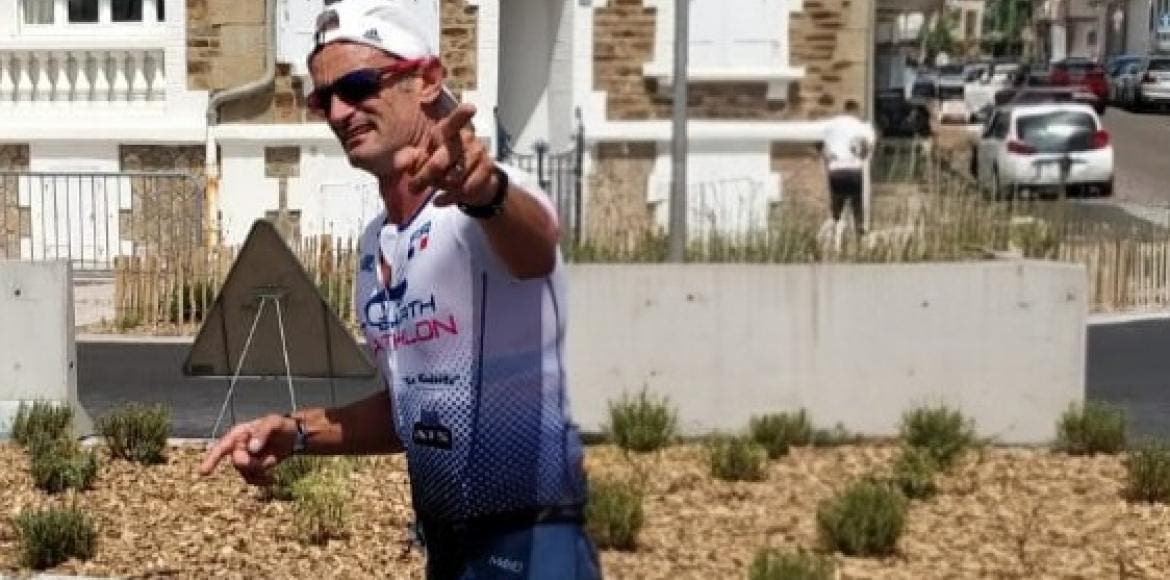
Triathlete, doctor and author of books on nutrition for sport, Fabrice Kuhn pulverized his record on the Ironman in the Sables of Olonne, in June 2025. In this article, he analyzed the reasons for this feat, which he owes largely to the teachings of his books Endurance science (volume 1 and volume 2) and Paleofit.
6 years without Ironman! 6 years since my race at the world championships in Kona. Back on the distance after 6 years without having to face it. However, I have not abandoned the triathlon and long distances but I experienced other things: 24 hours on a solo T24, the long triathlon of the Alpe d’Huez, the super challenge of the Vercorsman with a chain of 3 triathlons in 3 days including a long, half ironman … and even trail stages: the GTVD marathon (GTVD From the Drâa valley to Morocco) … What to have fun!
My preparation
I am always trained. But the preparation for this Ironman begins at the end of December after a block dedicated to the trail but without ever letting go of the bike or the swimming. Quickly, I realize that we will have to modify what I had done for my last Ironman. Over the past years, I feel that my training capacities differ. I cannot start on the same sessions and sequences. My VMA dropped a little. My recovery is a little slower. But when I prepare a goal, it’s to do my best.
In the chapter dedicated to “old” of Endurance science (“Efficient after 40 years”), we write that it is better to program for seniors, that they are less entitled to a small gap. I feel it well!
So I have better programmed. I identified the key sessions to give them their place. The base remains that of Paleofit. I have not completely revolutionized my training. But I slipped adaptations to better recover and better chain the sessions: fewer PMA/VMA blocks, PMA and VMA sessions less extreme … I have of course maintained bodybuilding work.
To find out more, read: Paleofit for endurance sports
PMA and VMA
PMA and VMA are key indications of performance.
– VMA (maximum aerobic speed): It is the smallest speed associated with VO2max. It is expressed in km/h.
– PMA (Maximum aerobic power): It is the smallest power associated with VO2max. It is expressed in watts (W).
VMA and PMA depend on VO2max but also on technical efficiency. VMA and PMA provide practical information to calibrate your training.
Attention PMA and VMA are not the maximums but simply maximum aerobic. Thus, the VMA is not the maximum speed but only the maximum aerobic speed; Higher speeds can be reached thanks to anaerobic processes.
It is also an opportunity to exploit the work done to Endurance science – Tome 1 And Endurance science – Tome 2. I have the material to exploit.
I continued my use of thelow glycogen training With a few sessions spread over the last 10 weeks but without doing more than one session per week by alternating carbohydrate -free biquotidian training and training in Sleep Low According to my schedule and my availability (Sleep Low : a session in the evening then “in bed without eating”, and a new training session the next morning on an empty stomach).
I did thedigestive training On a few sessions (rather long sessions with looks close to competitions). This makes it possible to better assimilate the carbohydrates in the race and make one stone two strokes: fewer digestive disorders, and more carbohydrates available for effort (therefore better performance). These large quantities of carbohydrates swallowed during the effort do not have the same impact as if they were swallowed outside the effort. These carbohydrates directly feed the muscles with effort and do not have the harmful effect for the health of excess carbohydrates outside of effort. In addition, they allow to anticipate recovery and limit muscle damage.
Sharpening (just before the competition) went well. I understood my acclimatization to heat there (it was hot when the preparation ends, it helps and I tried to train in the warmest of the day). Heat acclimatization is the best remedy for heat. I tried to reduce the mental load as much as possible to make myself as available as possible for competition, not to create mental fatigue and to be able to give everything possible in competition.
I prepared my self dialogue For the race: sentences to repeat, identification of predictable difficulties and strategies to be implemented if I found myself confronted.
Competition day
- Breakfast Classic before race (basmati rice, egg, banana).
- Always this little Race stress which disappears after a few meters in swimming.
- Swimming went well. I felt comfortable. Pleasant water temperature. And yet, average time (1h08). I have to do better. I don’t have the explanation! A navigation error? Maybe.
- Bike : stable intensity from start to finish (4:51). Very nice course, a little hilly, some reminders, nice country roads, villages, spectators, the atmosphere … Only negative point, always the same Nazes who draft! But it sometimes forces you to slow down to avoid drafter or sometimes to press really strong to double the platoons. Ehhhh guys and girls, if you want to draft change sports! Fortunately, the referees distributed some boxes!
- Running : Party a little faster than expected, but the sensations and the heart rate were good so I keep the look. Having deposited the bike in 6:10 am, I know that the 10 -hour bar is possible to cross. Mentally, I therefore hold on: focus on myself and what I can do, and not on other triathletes. I feel that the legs are good. I’m in a good day. And it is maintained until the end without really flexing, without real weariness. Of course, the last 20 kilometers are difficult but mentally it goes well!
Race power supply
Objective defined before race: at least 90 g of carbohydrates per hour of effort as I recommend it for efforts of more than 2:30. Objective reached!
Here is the distribution of my carbohydrates:
- 1 gel of 45 g of carbohydrates at the start;
- 1 gel of 45 g of caffeine carbohydrates on the bike, once launched so as not to waste time;
- 1 gel of 45 g to 50 g of carbohydrates every 30 min to fill my goal with 90 g of carbohydrates per hour.
Strategy held from start to finish without disgust and without digestive disorders.
Among these gels, two are coffee and distributed at strategic moments: bicycle mid-term for an effect on the end of the bicycle (30 to 60 min of action time) and just after T2 (second bicycle transition) for an action on the end of running.
I chose gels of 45 to 50 g of carbohydrates, containing sodium (for better assimilation or better hydration) and made up of glucose and fructose for better assimilation and fewer digestive disorders: indeed, when you aim at 90 g of carbohydrates per hour of effort, you have to pass on what are called multi -transport carboards (fructose and glucose). I varied the flavors for fun. Choosing a large 45 g carbohydrate gels allows me to eat less often and suddenly to have less oversight.
Hydration assessment
As I recommend, I drank my thirst throughout the test. This satisfies the needs of the body without risk of loss of performance linked to dehydration. I went on a bike with 3 cans: an electrolyte can and two drinking cans of the effort, including a mint flavor for its effect allowing to better support the heat. For running, I drank electrolyte drink distributed to supplies (which I had tested before) and sometimes a little water.
Heat management
I acclimatized to heat upstream (this is the most effective solution). During the bicycle, I tried to stop regularly to anticipate overheating. On foot, I got watered very regularly to limit overheating. I felt it was hot but I did not feel the deleterious effects.
The chapters of Endurance science particularly mentioned here
- Sharpening
- Self-dialogue in effort
- Effort drinks
- Caffeine
- Heat: how to prepare for it
- Heat: how to adapt during exercise
- Dehydration
- Manage the effort: the psychobiological model
- Carbohydrates for competition
- Hyperhydration: the dangers for the sportsman
- Menthol: effective help
- Efficient after 40 years