
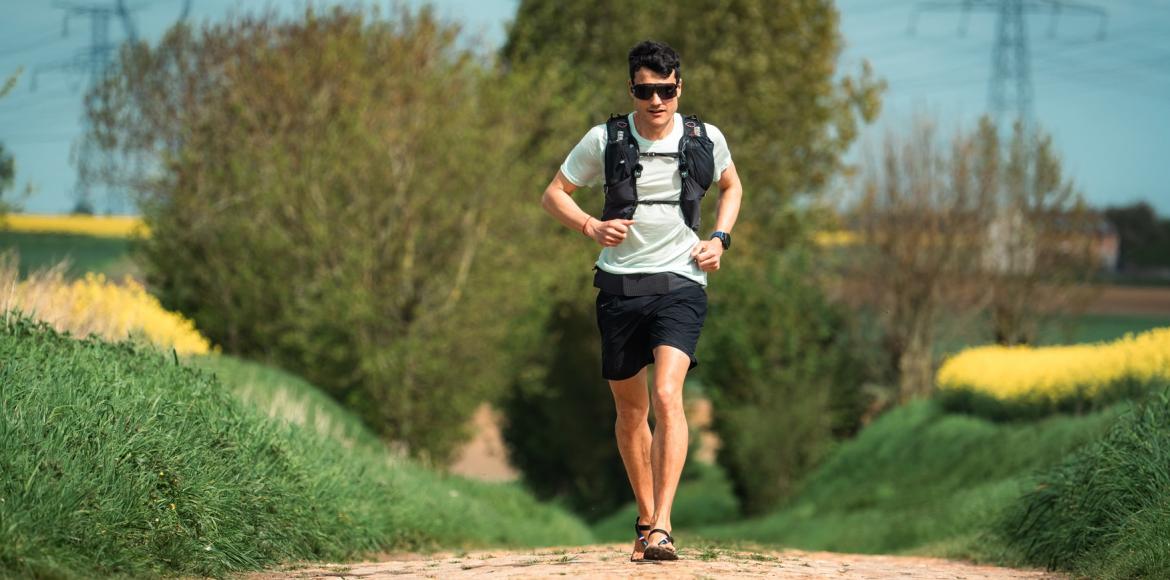
In April 2026, Olivier Maria crossed France in sandals, from the North Sea to the Mediterranean Sea in 11 days. A look back at this feat achieved with minimalist shoes.
Illustration © Jérôme Habasque
Author of the book Perform in ketogenic mode and passionate sportsman of long efforts, Olivier Maria (@lowcarbfrenchie) supports athletes in their transition to the ketogenic mode. A specialist in running with minimalist shoes, he returns with us on his journey from Dunkirk to Marseille.
Read: Olivier Maria: “Good fuel is a sine qua non condition for sporting performance”
Why this challenge of running from Dunkirk to Marseille?
I wanted to find out where my physical limits and in terms of endurance were on a project that was really long and took place over several days or even weeks. It’s a format that I experienced in bike races between 1000 and 2500 km (like the Race Across France) and this type of format is fascinating because beyond the physical effort, there is a whole part of effort management, sleep, logistics and nutrition which is super interesting. Doing while running what I have already done on a bike was also duplicating a concept but in an even more sober and minimalist way, without the need for any equipment: I could only rely on my legs.
Then there was an aesthetic notion, drawing a straight line from one sea to the other, I also found that quite beautiful and motivating.
Why run in sandals?
Running in sandals is getting back to the essence of running. Today nothing seems more natural than running in big shoes with a 4 cm thick sole, except that this fashion is brand new. Although there has been an escalation to the bigger shoe (or super-shops) for less than 10 years, in reality the modern running shoe has only been on the scene for a few decades. Human beings didn’t wait for cushioning or pronation control technologies to start running thousands of years ago!
Can you show us your shoes?
I run with sandals from the Panta Sandals brand, they are made in a very small workshop of two or three people in Haarlem, near Amsterdam. These sandals are in two parts: a sole that will protect me from the roughness of the terrain (there are models for the road, others for the mountains, and also “all-purpose” models which are my favorite) and a strap that will tighten the ankle so that the sandal stays in place while running.
How did you go from “classic” shoes to sandals?
My first pair of shoes was the one with the biggest sole and the most cushioning in the store because I was convinced I was making the best choice to protect my joints. A year later, I discovered minimalist running by reading the famous book Born To Run, and via La Clinique du Coureur, a pioneering organization in the popularization of science and the treatment of injuries.
Before switching to sandals, I started my transition by running in very thin shoes from conventional brands (the brands at the time had minimalist shoes that didn’t bear the name, which is no longer the case today) then I switched to sandals about 5 years ago.
Have you changed your stride?
I was lucky enough to switch to minimalist shoes shortly after starting because the longer you run, the longer it takes to adapt because the body has become accustomed to it. Running with shoes that have no cushioning requires changing your stride for lighter, more rhythmic and less noisy steps: you have to relearn your body to cushion and this can take several months (The Runner’s Clinic speaks of one month for every 10% of minimalist index between the 2 shoes).
Also during the transition period I advise keeping an alternation between your initial shoes and your pair of minimalist shoes: start by doing only 5 minutes with the minimalists at the end of each outing, then 7, then 10, to manage to do complete outings and finally put your old shoes in the closet for good.
The best advice Blaise Dubois gave me (which I would have liked to follow if I had had it earlier) was to prefer to run 5 minutes every day barefoot or minimally rather than once 45 minutes a week and have such pain in your calves that you can no longer walk for several days.
Read: The essentials for running well, without fatigue or injuries
You had already tried the experiment in 2025 but had to abandon it due to injury. How was the race in April?
I retired due to injury after 4 days and 430 km in October 2025 due to bacteria that infiltrated my foot. In order to put all the chances on my side before leaving again in April, I modified a certain number of parameters: run only on asphalt and eliminate passages along the way, limit interactions with the outside world as much as possible to concentrate on my effort…
I finally managed to reach Marseille after 1136 km which I ran in 10 days 11 hours 50 minutes running a little over 100 km per day. It’s a very special effort because you have to learn to run slowly but for a long time, at a pace that seems sustainable indefinitely but after a few days the body begins to tire and that’s when you have to be mentally strong. I ran for 3 days with quite severe pain and once I arrived in Marseille, I couldn’t have left for another day. But with the pride of having carried out this project which seemed completely crazy to me at first glance!
How did you eat during the race?
From my long bike races, I learned one thing: on this type of very long effort, you eat what you can find and you have to eat enough. I ate food in shops or bakeries, and I ate compotes, sandwiches, oilseeds… Anything that I wanted because we burn so many calories that we have to eat.
What are your projects?
I was followed throughout the journey by Jérôme Habasque to make a film which will hopefully be broadcast in early 2027. Jérôme followed me entirely by bike, it was important to us to produce a low-carbon film. On a sporting level, I’m taking the time to think about what’s next but my desire to run for a very long time is intact and I have some great ideas in my head, to see when and how I will be able to complete them!