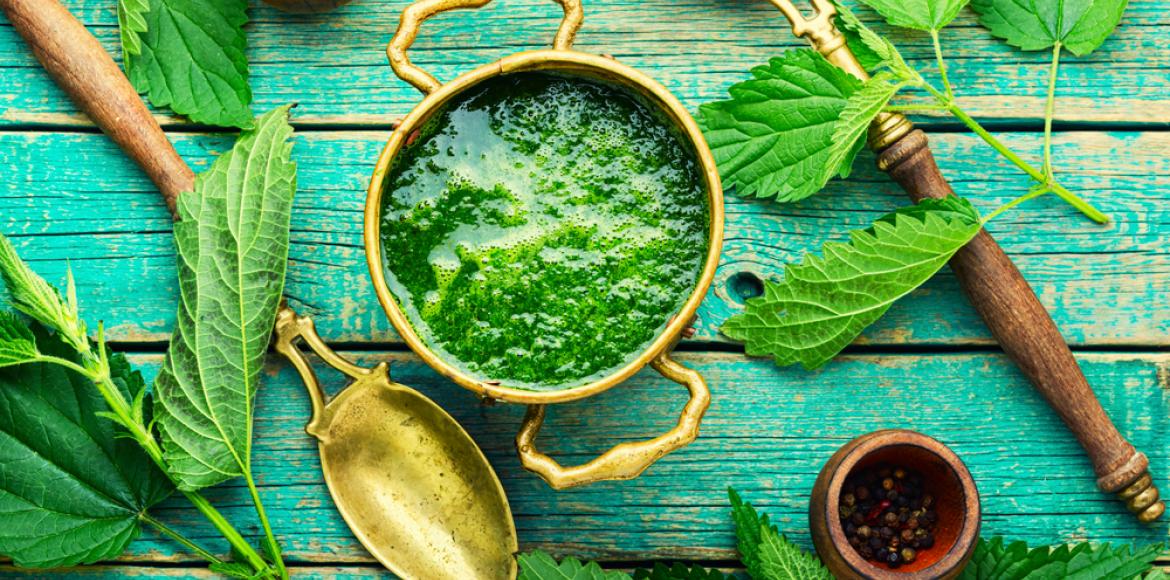
Behind its stinging leaves, the nettle (Urtica dioica) reveals exceptional nutritional and medicinal richness. Between ancient traditions and recent scientific discoveries, it stands out as a valuable ally for health and the environment.
Long considered a weed, nettle (Urtica dioica) is today perceived differently. It now appears as a symbol of resilience, capable of growing in difficult environments, but also as a plant closely linked to ecological transition. It represents an example of rediscovered traditional knowledge and demonstrates a renewed interest in wild plants.
The story of the nettle
The use of nettle dates back to Antiquity, where Hippocrates already mentioned it in his medical practices. The Romans used stinging, a practice of whipping oneself with fresh nettles to stimulate blood circulation and relieve rheumatism. In the Middle Ages, the nettle was an essential resource in European rural societies. It was eaten as a vegetable in spring, included in pharmacopoeias and used as a textile fiber. These historical uses are today confirmed by studies showing that nettle has a high nutritional density and a wide diversity of applications.
The different species of nettles
The gender Urtica includes several species, the most studied of which are Urtica dioica And Urtica urens.
- Urtica dioicathe nettle, is a widely distributed perennial species, and the most used in herbal medicine due to its richness in bioactive compounds (see below).
- Urtica urensthe burning nettle, shrike nettle or little nettle, is a smaller annual plant, known for a more marked stinging activity. It is traditionally used for its diuretic and dermatological effects, although less studied pharmacologically.
The nutritional richness of nettle
Nettle contains a wide variety of active compounds, including flavonoids, phenolic acids, carotenoids, fatty acids and sterols. These compounds give the plant strong antioxidant activity. Furthermore, nettle is rich in vitamins (A, C, K) and essential minerals such as iron and calcium, which explains its traditional use as a remineralizing plant (1).
This composition explains why it is today considered a functional food.
The medicinal properties of nettle
Nettle (Urtica dioica) has many medicinal properties linked to its richness in bioactive compounds, including flavonoids, polyphenols and certain organic acids. These substances give it anti-inflammatory, antioxidant and protective effects on the body.
First of all, it has a diuretic effectpromoting renal elimination and contributing to the management of benign urinary disorders. This property is attributed to the presence of flavonoids and mineral salts. Nettle root is widely used in disorders related tobenign prostatic hyperplasia (HBP). It would act by modulating certain hormonal interactions, in particular those involving testosterone and dihydrotestosterone, thus contributing to the improvement of urinary symptoms (2).
Regarding the allergiesnotably allergic rhinitis, some studies suggest that nettle could modulate the immune response and inhibit the release of inflammatory mediators such as histamine, which could explain its use (3).
It also has an effect tonic and anti-stressprobably linked to its richness in magnesium, B group vitamins and antioxidant compounds, contributing to the proper functioning of the nervous system (3).
Thanks to its high content of iron and vitamin C, nettle is used in cases ofanemia and fatigue. These nutrients promote the formation of red blood cells and improve iron absorption (1, 3).
Its properties anti-inflammatories and analgesics also make it a traditional remedy against joint painparticularly in rheumatism. Studies have shown that its extracts can inhibit certain inflammatory pathways (1, 3, 4, 5).
It is particularly studied in the context of metabolic syndromewhere it could help reduce certain risk factors such as hypertension, high cholesterol and high blood sugar. Its hypotensive effects would be linked to an action on ion channels, while its antihyperlipidemic properties would be based on the inhibition of cholesterol synthesis and the reduction of oxidative stress. Quercetin, present in nettle, also plays a role in lowering cholesterol (3, 6).
Regarding the type 2 diabetesclinical studies suggest that nettle could reduce fasting blood sugar, in particular by stimulating insulin secretion, although the results still remain partial and need to be confirmed (7).
Read: Type 2 diabetes: 12 allied plants
Nettle also has effects hypotensivesas well as a potential protective role with respect to the cardiovascular system (3, 5).
Picking nettle
In the field, the nettle can be recognized by its toothed leaves, its quadrangular stem and its characteristic stinging hairs. It grows in environments rich in nitrogen, often linked to human activity.
The harvest is preferably carried out in spring, when the young shoots have the best nutritional quality. This period also corresponds to a high concentration of active compounds, which explains its traditional use during spring cures.
To pick it, some precautions are essential:
- wear gloves;
- use scissors or a knife;
- cut off the tops (5–10 cm).
Nettle in cooking: between tradition and modernity
Nettle also appears on our plates, with remarkable nutritional qualities. It is traditionally consumed in soup, especially in spring, where it helps to remineralize the body thanks to its richness in micronutrients.
The stinging nature of the nettle is due to its hairs containing irritating substances, but these compounds are quickly inactivated by heat or drying. Thus, once cooked, mixed or dried, the nettle becomes perfectly edible.
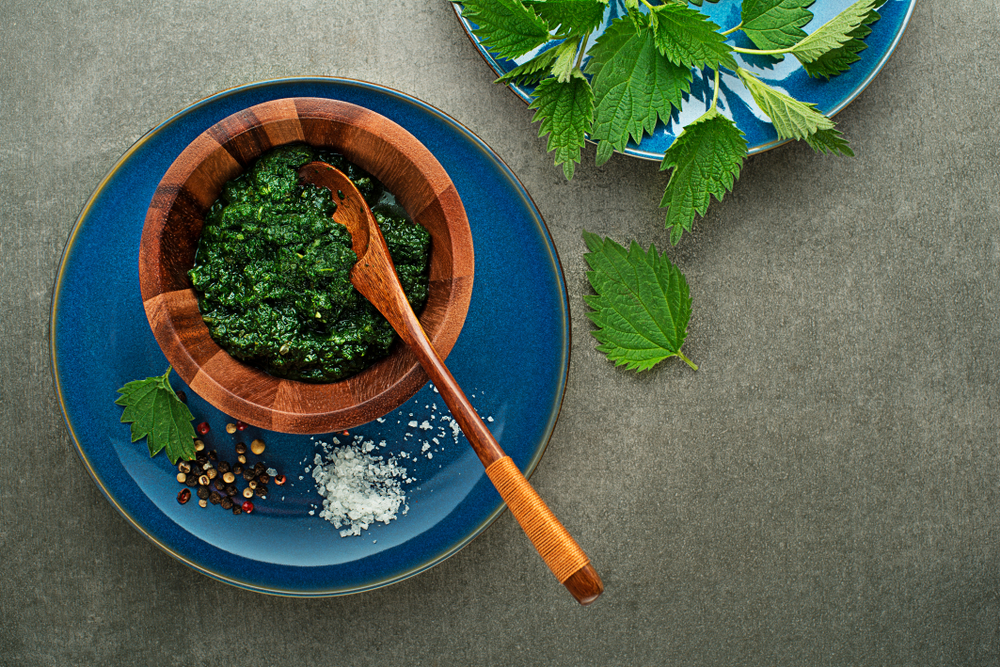
Preparations, such as nettle pesto, make it possible to enhance its taste qualities while retaining its nutritional properties. In the form of an infusion, it acts as a general tonic and a remineralizer.
Nettle soup
Ingredients
- 2 handfuls of fresh nettles
- 2 potatoes
- 1 onion
- 1 liter of water
- Vegetable oil
- Salt, pepper
Preparation
Brown the onion in olive oil. Add the potatoes and cover with water and cook for 25 minutes. Add the nettles, then mix after 5 minutes of cooking.
Other recipes:
-
Nettle pesto
-
Wild salad
-
References
-
Historical
-
Bhusal KK, Magar SK, Thapa R, Lamsal A, Bhandari S, Maharjan R, Shrestha S, Shrestha J. Nutritional and pharmacological importance of stinging nettle (Urtica dioica L.): A review. Heliyon. 2022 Jun 22;8(6):e09717. doi: 10.1016/j.heliyon.2022.e09717. PMID: 35800714; PMCID: PMC9253158.
-
Safarinejad. Urtica dioica for treatment of benign prostatic hyperplasia: A prospective, randomized, double-blind, placebo-controlled, crossover study. Journal of Herbal Pharmacotherapy. 2005.
-
El Kahkahi R, Moustaine M, Zouhair R. Urtica dioica L.: A Comprehensive Review of its Phytochemical Composition and Pharmacological Properties. Med. Pharm. J. 2025 Jul. 22 (cited 2026 Apr. 24);4(2):64-78. Available from: https://pharmacoj.com/ojs/index.php/Medph/article/view/121
-
Chrubasik et al. A comprehensive review on the stinging nettle effect and efficacy profiles. Part II: urticae radix. Phytomedicine. 2007.
-
Đurović S, Kojić I, Radić D, Smyatskaya YA, Bazarnova JG, Filip S, Tosti T. Chemical Constituents of Stinging Nettle (Urtica dioica L.): A Comprehensive Review on Phenolic and Polyphenolic Compounds and Their Bioactivity. Int J Mol Sci. 2024 Mar 18;25(6):3430. doi:10.3390/ijms25063430. PMID: 38542403; PMCID: PMC10970493.
-
Samakar B, Mehri S, Hosseinzadeh H. A review of the effects of Urtica dioica (nettle) in metabolic syndrome. Iran J Basic Med Sci. 2022 May;25(5):543-553. doi: 10.22038/IJBMS.2022.58892.13079. PMID: 35911652; PMCID: PMC9282742.
-
Ziaei R, Foshati S, Hadi A, Kermani MAH, Ghavami A, Clark CCT, Tarrahi MJ. The effect of nettle (Urtica dioica) supplementation on the glycemic control of patients with type 2 diabetes mellitus: A systematic review and meta-analysis. Phytother Res. 2020 Feb;34(2):282-294. doi:10.1002/ptr.6535. Epub 2019 Dec 4. PMID: 31802554.
-
Current version
on 05/22/2026 - on 05/21/2026