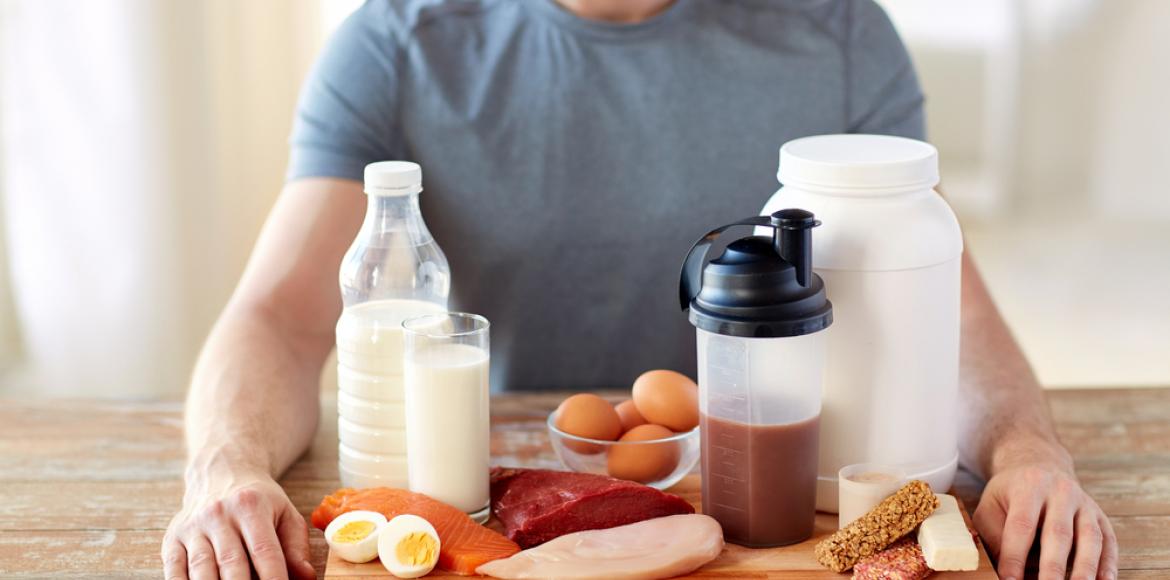
Protein needs when practicing bodybuilding are twice the recommended intake for a sedentary person, especially after the age of 40.
What is protein?
Definition
Proteins are fundamental materials of living matter. Most of our foods contain it. Biochemically, they are large molecules made up of variable length chains of amino acids. All proteins, whether of bacterial, plant or animal origin, are made up of a group of 20 amino acids.
Role
Proteins are the “building blocks” of the body. They make it possible to manufacture muscles, bones, hair, nails, skin… All organs, but also hormones, enzymes and antibodies… Food proteins are a source of energy (amino acids provide energy during their degradation in quantities equivalent to that provided by carbohydrates).
Protein requirements
Protein needs are daily, because tissues are constantly renewing themselves (at a rate of at least 250 to 300 g per day).
For a young adult, they are around 0.6 g per kg of body weight per day. The ANC* were calculated on this basis. For adults, the recommended nutritional intake of good quality protein is 0.8 g per kg of body weight per day (i.e. for example 44 g for a 55 kg woman and 60 g for a 75 kg man). These needs are increased for athletes who wish increase their muscle mass and their performance.
The best sources of dietary protein (animal, vegetable)
A protein is of good nutritional quality if it contains the eight essential or essential amino acids – those that the body cannot produce and which must be supplied through food – in the ideal proportions, that is to say in the proportions adapted to the needs of the body. The protein must also be perfectly digestible.
To evaluate the nutritional quality of a protein, two parameters must therefore be taken into account: its composition of essential amino acids and its digestibility.
The ideal is to vary the sources: lAnimal proteins (meat, eggs, milk) have similar characteristics: they are very digestible, they have high contents of essential amino acids with a profile quite close to that of human needs.
Proteins of plant origin mainly come from cereals (wheat, rice, corn) and legumes (chickpeas, beans, soya, lentils, beans). Their nutritional characteristics are more diverse than those of animal proteins. Their digestibility is on average slightly lower and varies enormously from one source to another. Their content of essential amino acids is generally lower (around 40% of amino acids) and their profile is further from that of the body’s needs, but it is entirely possible to cover protein needs from plant sources, all you need to do is vary the foods consumed.
How much protein per day to get build muscle ?
Bodybuilding: protein intake is essential
Muscles are made primarily of protein. When we strength train, we strain our muscles and cause tiny damage to muscle tissue which then needs new dietary proteins to repair. This repair involves a cellular process that leads to an increase in contractile proteins (actin and myosin) and the number of sarcomeres, the filaments that line muscle fibers. This increases the diameter of individual fibers and leads to hypertrophy of the muscle.
Proteins promote muscle mass gain
Bodybuilding enthusiasts often resort to protein-enriched drinks or supplements to support the growth of muscle mass. Studies show that in general, increasing your protein intake helps an increase in muscle mass and a significant reduction in fat, particularly abdominal fat. It remains to be seen how much dietary protein should be available.
Strength training has many health benefits, helping you stay slim and fight diabetes. But if you want to gain mass and strength, you need to consume enough protein. According to the results of a study published in the journal British Journal of Sports Medicine these needs go beyond the recommended intakes, particularly after the age of 40.
Many previous studies carried out on the subject have focused either on a type of protein or on a specific population. In this new study, the researchers brought together the work carried out on the relationship between bodybuilding and protein intake. They took into consideration 49 studies lasting at least 6 weeks, with control groups, protein intakes as well as varied populations.
The results clearly show that you need to consume a lot of protein to increase muscle volume and strength. Thus, men and women who consumed more protein gained an additional 10% in muscle strength and 25% in muscle mass compared to the control groups.
Also read:
-
Bodybuilding: rice proteins as effective as whey
-
Protein supplements to improve sports performance
-
How much protein do you need? (subscribers)
How many grams of protein per kg of body weight (men, women)?
According to the study results, the ideal amount of protein is approximately 1.6 grams per kilogram of body weight per day. This represents approximately 130 grams of protein for an 80-kilogram man and almost 100 grams for a 60-kilogram woman. Well beyond the recommendations for the general population which are around 0.8 grams/kg of body weight. Some authors recommend 2 to 3 grams of protein per kilo of weight, but consuming more than 1.6 g/kg would not provide additional benefits for muscle mass and strength. All proteins are likely to be effective. So, chicken, beef, yogurt, quinoa, soy, etc. can help develop muscle mass. Protein is not only found in animal products. Vegetarians and vegans also have at their disposal good quality protein. Finally, regardless of when proteins are consumed, before or after training, the results for your body are the same. You can supplement your food ration with proteins in the form of food supplements such as whey (whey protein), or even soy and rice protein powders.
Note that the researchers found that this advice to eat enough protein was particularly suitable for people aged over 40 who did not consume enough protein and who therefore did not reap enough of the benefits of bodybuilding.
Supplementation to increase your daily protein intake
Rice or whey protein?
Which protein powder to choose? A study showed that rice proteins and whey proteins have the same effectiveness in improving physical performance and body composition in athletes. Rice protein and whey decreased fat and increased muscle thickness to the same extent during the study. To help you make the right choice, read our article.
How much whey per day?
It is possible to supplement your dietary protein ration with supplemental protein powder, such as whey. By taking into account your diet plus your supplementation, the amount of protein should not exceed 1.6 g of protein per kilo of body weight. Beyond that, there do not appear to be any significantly different effects.
What is the hazard of eat too much protein?
Excessive consumption of protein foods can have harmful consequences: increased urea, increased uric acid (gout), acidification of the body which promotes bone loss.
For indication: quantity of proteins in the main foods
| Food | Amount of protein |
| 100 g of legumes or oilseeds | 20 to 25g |
| 100 g of fish, meat or offal | 15 to 25g |
| 100 g of poultry or ham | 18 to 20g |
| 2 eggs | 15 to 18g |
| 100 g of cereals | 8 to 12g |
| 30 g of Emmental | 9g |
| 1 yogurt | 4 to 7g |
| 175 g broccoli | 4 to 5g |
3 books that we recommend:
- Athletic bodybuildingby Christophe Carrio
- Strength Nutritionby Julien Venesson
- The base of strengthby Christophe Bonnefont
-
Historical
-
Current version
11/17/2025 - on 02/18/2025
- on 01/23/2025
- on 02/16/2018